
Consonism
A Theory of Art and Psychological Reorganization
Poyan Bedayat, 2026
7.1 — Externalization and Artistic Persistence
Corrective and developmental composition require consequences generated under differently accessible references to remain jointly available, revisable, and consequential long enough for reciprocal interaction to accumulate. Art can provide a field in which a psychological consequence remains perceptible after the state that produced it has receded. A feeling, expectation, memory, value, or capacity that influences activity only briefly may leave a configuration the artist can later encounter under changed psychological conditions. The consequence can thereby outlast the access through which it was produced and re-enter activity without requiring simultaneous activation of its source. Art thus extends the period over which otherwise separated organizations can bear upon one development despite discontinuities in their accessibility. This capacity makes art neither the only field of composition nor an inherently corrective or developmental activity. Its first theoretical importance lies specifically in producing and preserving perceptible consequences.
Externalization is the production of a persistent, perceptible consequence in an external medium under the influence of a psychological reference. A reference may guide attention, selection, rhythm, pressure, omission, sequence, relation, revision, and stopping without appearing as the work's explicit subject. Grief need not be represented by an image of loss, nor hope stated as a proposition, for either organization to affect what is made. Explicit representation may occur, but it is neither necessary nor sufficient for externalization in this sense. The relevant relation concerns how production is organized, not whether psychological content is recognizable. Externalization requires neither confession, symbolic depiction, nor deliberate communication of an internal state. It gives perceptible form to consequences produced while a reference is operative.
Externalization does not transfer a psychological reference into the work or reproduce an internal state outside the person. The realized configuration is a new event within the artistic field whose production has been partly organized by that reference. Medium-specific constraints also participate. Material resistance, duration, scale, technique, convention, prior decisions, available tools, and the work's existing condition constrain what can be realized. These constraints transform what psychological organization can produce, so no direct correspondence between inner state and external form should be assumed. The configuration is neither a copy of an inner condition nor a pure product of the medium. It is a perceptible consequence produced through the encounter between psychologically organized activity and the possibilities and resistances of artistic material.
Persistence is the continued perceptual availability of an artistic configuration after the psychological state that generated it has weakened, disappeared, or changed. It is relative and medium-dependent rather than permanent. A painted mark may remain materially present; a performed gesture may persist through recording, notation, rehearsal, or effects on a later sequence; a temporary arrangement may remain only long enough to influence the next decision. Different media therefore preserve through different material, procedural, or mnemonic supports, and none establishes persistence merely by producing an object. Indefinite durability is not required. A consequence may persist for minutes if that interval permits a later encounter under altered conditions. The criterion is whether it remains available after its originating conditions no longer govern activity in the same way.
Artistic persistence differs from persistence bias. The first concerns continued perceptual availability of a realized configuration; the second concerns the unequal tendency of relational configurations to be sustained, re-entered, extended, or translated. A work can preserve a consequence that is psychologically difficult to reproduce, while a recurrent psychological organization may leave no durable trace. Continued presence also does not mean that the source reference remains active or that its earlier meaning has been stored unchanged. The work preserves a consequence, not the state, reference, or event in its original form. The preserved consequence can also support comparison across differently organized states. A persistent configuration may later support, oppose, or fail to evoke the organization that influenced it. The artist may be unable to recover the earlier state or may interpret it differently while the configuration remains available.
Re-encounter is therefore a new event rather than a replay of production. Another psychological reference may be active, the originating reference may have changed, the artistic context may have developed, and adjacent configurations may have altered what the consequence permits or demands. Its significance is generated through this new relation among configuration, active grading, and the work's accumulated state. The artist may register it as coherent, false, dangerous, evasive, promising, incomplete, or newly significant. It can provide feedback by being retained, revised, opposed, extended, displaced, repeated, or removed. Each response produces further consequences and changes the field encountered by later action. Persistence gives a consequence a continuing developmental role without fixing its meaning or value in advance.
Three forms of availability must remain distinct: a reference's existence within the psychological repertoire, its accessibility in a present state, and the perceptual availability of an artistic consequence. A work can secure the third without guaranteeing the first two. A configuration generated while a reference was briefly accessible may remain perceptible after the reference recedes, and re-encounter may help reactivate it. Reactivation is possible rather than assured, and perceptual availability is not equivalent to psychological access. The configuration may fail to restore its source organization or acquire meaning under another reference. Externalization and persistence support the field condition for composition, but establish neither co-influence, reciprocity, nor an adaptive result. They preserve an opportunity for later participation rather than the participation itself, especially across fluctuating states that would otherwise prevent sustained comparison. Work and medium enable encounters; they do not remember, judge, or integrate.
Consider an artist whose grief has organized attention, rhythm, imagery, and expectation through a predominantly closed future. During a temporary change in accessibility, another established organization makes tenderness, continued attachment, or meaningful continuation briefly operative. The artist writes a line under this influence. The line need not declare that hope or tenderness has appeared. Their consequences may become perceptible through altered rhythm, an unexpected address, a change of tense, a spatial opening, or an image permitting continued relation where surrounding writing tends toward closure. The medium converts the brief shift into a particular arrangement of language that neither reproduces nor exhausts it. A psychological variation has acquired linguistic form. This is externalization.
By the following day, the softening may have disappeared, and grief may again organize the future through closure or meaninglessness. The line nevertheless remains beside passages written under grief's stronger influence. This is persistence. The work has not preserved tenderness, hope, or openness as an internal state, nor guaranteed that the artist will recognize the line's earlier source. The artist may be unable to reproduce that state and may no longer regard the line as faithful to the loss. What remains is a linguistic consequence generated while another organization was operative. Its perceptible presence allows the earlier variation to survive changing accessibility without requiring its source to remain active.
On returning to the work, the artist may experience the line as tender, false, sentimental, evasive, dangerous, incomplete, or unexpectedly truthful. It may help make the earlier organization accessible again, fail to do so, or become significant differently. The artist can retain, cut, relocate, repeat, interrupt, or revise it. Each action produces another perceptible consequence and changes what will be encountered next. The returned line can thus affect later activity even when its originating state remains unavailable. Persistence has converted a fleeting psychological variation into material for renewed judgment and artistic development. It has not established how grief and the alternative organization jointly grade the line or how their consequences begin altering one another.
Externalization and persistence allow artistic activity to accumulate perceptible consequences across changes in psychological accessibility. A mark, phrase, sound, gesture, movement, or spatial relation can remain available when its source organization is inactive and receive later feedback under altered conditions. This temporal extension permits differently organized acts to enter one revisable artistic history. Preservation is necessary for this history but insufficient for composition. It may yield only an archive of separate traces. Consequences can coexist without several relevant references grading and shaping the same work, without formal relations that keep their differences consequential, and without reciprocal alteration. The remaining problem is how preserved traces become causally active through judgments within one developing work.
7.2 — Artistic Judgment and Joint Participation
A persistent artistic configuration becomes psychologically consequential again when an active reference grades it relative to its constraints and the developing work. The configuration carries no fixed psychological meaning from its production. What it can mean now depends partly upon the reference presently operative and upon relations the work has acquired since the configuration was made. On re-encounter, the artist may register whether it feels faithful, false, necessary, excessive, evasive, incomplete, misplaced, or capable of further development. This grading returns the preserved consequence to artistic action. The artist may retain, revise, oppose, move, intensify, or remove it according to how the active reference and existing work constrain what can follow. The same configuration can consequently prompt different actions under different gradings. It does not judge itself; it becomes consequential through the person's renewed encounter.
Artistic judgment is the felt, embodied, or reflective recognition of how an artistic possibility is graded relative to an active reference and the developing work. It may occur as tension, attraction, resistance, unease, rhythmic expectation, bodily rightness, or explicit evaluation. It guides selection, placement, timing, emphasis, revision, rejection, and stopping. Judgment is exercised by the artist rather than the work or medium, but need not be fully conscious or verbal. It also operates within formal and medium-specific constraints; felt rightness does not free the artist from what material consequences disclose. Judgment remains fallible. Habit, avoidance, convention, pathology, preference, or a locally economical restriction may appear as compelling as adaptive insight. Reflection may revise an embodied judgment, and later feedback may overturn a reflective one. Certainty does not establish developmental adequacy.
Compound judgment is the result of multiple active references grading the same configuration under different or opposing constraints. The artist may experience attraction and resistance together because one reference supports a possibility another treats as false, dangerous, disloyal, incoherent, or premature. The gradings may differ in strength or clarity, and one may become explicit while another is registered only as unease. Compound judgment is not a separate faculty above the participating references and does not resolve their conflict. It is an artistic form of co-influence: several reference-relative consequences bear upon one developing work. Their joint presence establishes that more than one organization remains consequential, but the references may remain unchanged, and no continuation may yet accommodate what each preserves. A difficult judgment is therefore not composition simply because it contains several pressures.
Joint participation creates a double formal problem. One reference may close the continuation before others affect it: a configuration can be deleted, overwritten, normalized, or forced into the governing organization's familiar meaning. The work then becomes coherent by excluding a relevant demand. Preventing domination creates an opposite risk. If every consequence is merely retained as a separate trace, the work fragments into configurations that coexist without changing what one another makes possible. Difference remains visible but causally insulated. The work must therefore remain open enough for incompatible continuations to stay consequential and organized enough for changes in one consequence to matter to the others. Openness without relation and relation without openness each defeat development, although either may still produce a superficially persuasive work.
Formal ambiguity is an artistic organization that keeps incompatible continuations consequential and underdetermined without forcing either to premature completion. Underdetermination means that the work has not settled which continuation will govern, not that nothing has been formally determined. The alternatives must be materially supported by actual relations—through rhythm, syntax, image, gesture, sequence, spatial structure, sound, movement, or other medium-specific organization. Ambiguity is not vagueness, obscurity, confusion, indecision, or absence of formal commitment. Its constraints can be exact even while the continuation remains open. It resists premature closure by allowing more than one grounded judgment to constrain what the work can become. The ambiguity need not remain permanent; later development may transform the alternatives or reorganize their relation.
Formal organization is the coherence produced by formal and medium-specific constraints that allows different consequences to remain parts of one perceptible, developing work. It establishes relations through which a change in one configuration alters the significance and possibilities of others. A line acquires different force when relocated, an image changes earlier passages when it recurs, and an interruption can reorganize a rhythm that preceded it. Coherence does not require harmony, smoothness, stylistic unity, balance, or absence of dissonance. A work may be organized through tension, discontinuity, asymmetry, interruption, instability, or unresolved contrast. Organization concerns causal and perceptual relatedness rather than conventional unity. What matters is that differentiated elements are not merely adjacent: placement, recurrence, variation, sequence, or material relation makes them consequential within one field.
Formal ambiguity and formal organization perform complementary functions. Ambiguity without sufficient organization can yield fragmentation: multiple consequences remain present but do not affect one another. Organization without sufficient ambiguity can yield premature closure: one judgment fixes the continuation before other relevant consequences participate. Together they can keep differentiated consequences jointly available, revisable, and consequential across artistic feedback. Their balance is configuration-specific; no fixed amount of ambiguity or organization is correct for every work. Continued revision is needed to test how that balance functions. They do not act, judge, or integrate on their own and guarantee neither reciprocity nor adaptation. The artist must continue encountering and responding through psychological references. The formal conditions establish a field in which differently organized judgments can bear upon one development long enough for mutual alteration to become possible.
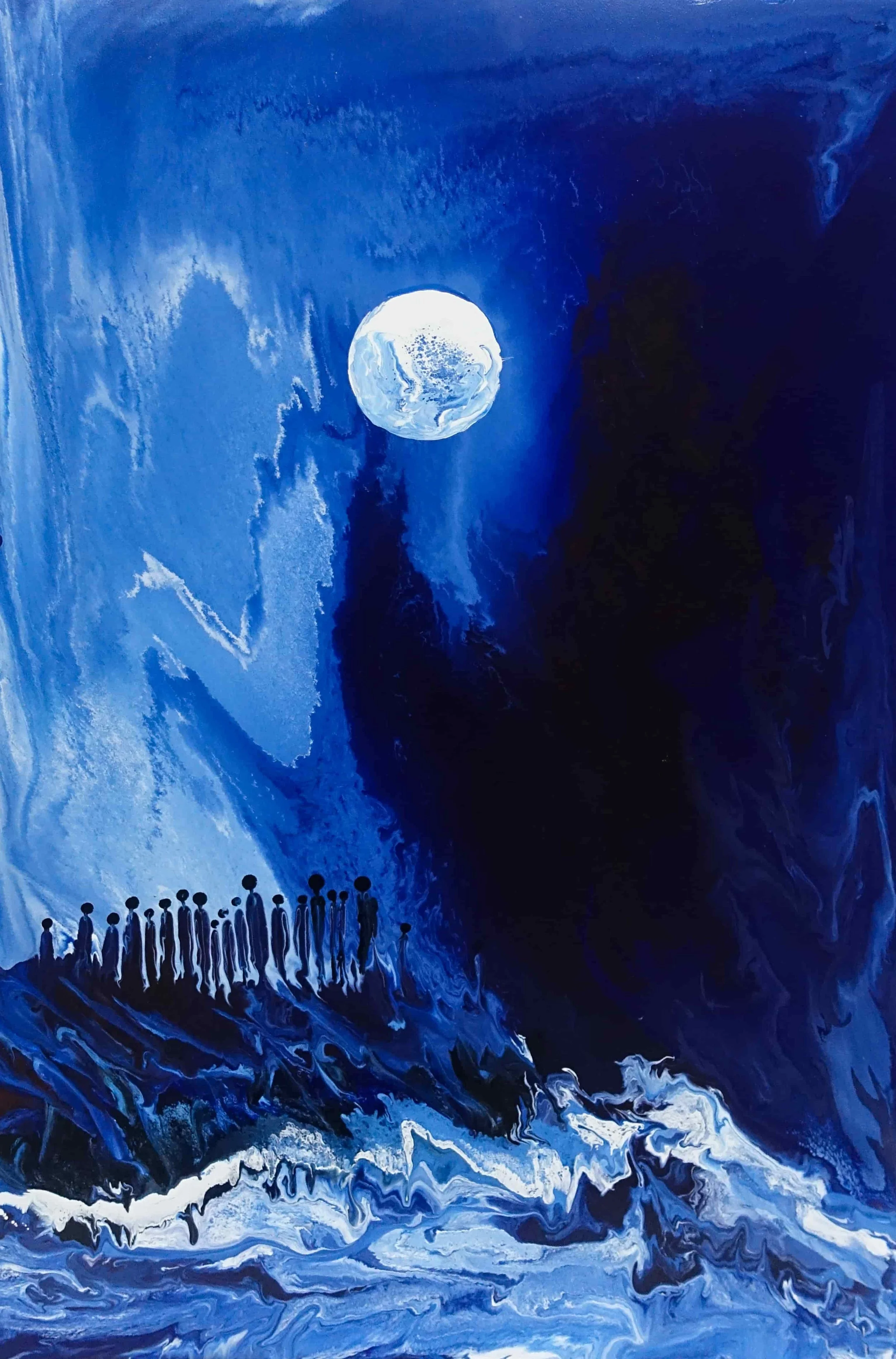
Consider, for example, Brumand's Storm and Moonlight Painting, in which psychological references organized around fear and hope leave jointly consequential effects within one formally organized field. By her account, the pale moon and calmer regions of light evoke life, hope, and possibility, while the dark, turbulent night evokes fear, death, and loss. The ocean and standing figures remain answerable to both organizations. The ocean is chaotic and threatening yet luminous beneath the moonlight; the figures appear dark and apprehensive yet remain standing within the light, as though facing a possible future. These relations sustain compound judgments—dangerous yet consoling, exposed yet enduring—without requiring either continuation to govern the work completely. The painting therefore illustrates how formal ambiguity can keep conflicting consequences perceptible and consequential within a coherent field. It does not by itself establish that fear and hope have entered composition or formed a consonant bond.
7. Consonist Art
7. Consonist Art
7.1 — Externalization and Artistic Persistence
Corrective and developmental composition require consequences generated under differently accessible references to remain jointly available, revisable, and consequential long enough for reciprocal interaction to accumulate. Art can provide a field in which a psychological consequence remains perceptible after the state that produced it has receded. A feeling, expectation, memory, value, or capacity that influences activity only briefly may leave a configuration the artist can later encounter under changed psychological conditions. The consequence can thereby outlast the access through which it was produced and re-enter activity without requiring simultaneous activation of its source. Art thus extends the period over which otherwise separated organizations can bear upon one development despite discontinuities in their accessibility. This capacity makes art neither the only field of composition nor an inherently corrective or developmental activity. Its first theoretical importance lies specifically in producing and preserving perceptible consequences.
Externalization is the production of a persistent, perceptible consequence in an external medium under the influence of a psychological reference. A reference may guide attention, selection, rhythm, pressure, omission, sequence, relation, revision, and stopping without appearing as the work's explicit subject. Grief need not be represented by an image of loss, nor hope stated as a proposition, for either organization to affect what is made. Explicit representation may occur, but it is neither necessary nor sufficient for externalization in this sense. The relevant relation concerns how production is organized, not whether psychological content is recognizable. Externalization requires neither confession, symbolic depiction, nor deliberate communication of an internal state. It gives perceptible form to consequences produced while a reference is operative.
Externalization does not transfer a psychological reference into the work or reproduce an internal state outside the person. The realized configuration is a new event within the artistic field whose production has been partly organized by that reference. Medium-specific constraints also participate. Material resistance, duration, scale, technique, convention, prior decisions, available tools, and the work's existing condition constrain what can be realized. These constraints transform what psychological organization can produce, so no direct correspondence between inner state and external form should be assumed. The configuration is neither a copy of an inner condition nor a pure product of the medium. It is a perceptible consequence produced through the encounter between psychologically organized activity and the possibilities and resistances of artistic material.
Persistence is the continued perceptual availability of an artistic configuration after the psychological state that generated it has weakened, disappeared, or changed. It is relative and medium-dependent rather than permanent. A painted mark may remain materially present; a performed gesture may persist through recording, notation, rehearsal, or effects on a later sequence; a temporary arrangement may remain only long enough to influence the next decision. Different media therefore preserve through different material, procedural, or mnemonic supports, and none establishes persistence merely by producing an object. Indefinite durability is not required. A consequence may persist for minutes if that interval permits a later encounter under altered conditions. The criterion is whether it remains available after its originating conditions no longer govern activity in the same way.
Artistic persistence differs from persistence bias. The first concerns continued perceptual availability of a realized configuration; the second concerns the unequal tendency of relational configurations to be sustained, re-entered, extended, or translated. A work can preserve a consequence that is psychologically difficult to reproduce, while a recurrent psychological organization may leave no durable trace. Continued presence also does not mean that the source reference remains active or that its earlier meaning has been stored unchanged. The work preserves a consequence, not the state, reference, or event in its original form. The preserved consequence can also support comparison across differently organized states. A persistent configuration may later support, oppose, or fail to evoke the organization that influenced it. The artist may be unable to recover the earlier state or may interpret it differently while the configuration remains available.
Re-encounter is therefore a new event rather than a replay of production. Another psychological reference may be active, the originating reference may have changed, the artistic context may have developed, and adjacent configurations may have altered what the consequence permits or demands. Its significance is generated through this new relation among configuration, active grading, and the work's accumulated state. The artist may register it as coherent, false, dangerous, evasive, promising, incomplete, or newly significant. It can provide feedback by being retained, revised, opposed, extended, displaced, repeated, or removed. Each response produces further consequences and changes the field encountered by later action. Persistence gives a consequence a continuing developmental role without fixing its meaning or value in advance.
Three forms of availability must remain distinct: a reference's existence within the psychological repertoire, its accessibility in a present state, and the perceptual availability of an artistic consequence. A work can secure the third without guaranteeing the first two. A configuration generated while a reference was briefly accessible may remain perceptible after the reference recedes, and re-encounter may help reactivate it. Reactivation is possible rather than assured, and perceptual availability is not equivalent to psychological access. The configuration may fail to restore its source organization or acquire meaning under another reference. Externalization and persistence support the field condition for composition, but establish neither co-influence, reciprocity, nor an adaptive result. They preserve an opportunity for later participation rather than the participation itself, especially across fluctuating states that would otherwise prevent sustained comparison. Work and medium enable encounters; they do not remember, judge, or integrate.
Consider an artist whose grief has organized attention, rhythm, imagery, and expectation through a predominantly closed future. During a temporary change in accessibility, another established organization makes tenderness, continued attachment, or meaningful continuation briefly operative. The artist writes a line under this influence. The line need not declare that hope or tenderness has appeared. Their consequences may become perceptible through altered rhythm, an unexpected address, a change of tense, a spatial opening, or an image permitting continued relation where surrounding writing tends toward closure. The medium converts the brief shift into a particular arrangement of language that neither reproduces nor exhausts it. A psychological variation has acquired linguistic form. This is externalization.
By the following day, the softening may have disappeared, and grief may again organize the future through closure or meaninglessness. The line nevertheless remains beside passages written under grief's stronger influence. This is persistence. The work has not preserved tenderness, hope, or openness as an internal state, nor guaranteed that the artist will recognize the line's earlier source. The artist may be unable to reproduce that state and may no longer regard the line as faithful to the loss. What remains is a linguistic consequence generated while another organization was operative. Its perceptible presence allows the earlier variation to survive changing accessibility without requiring its source to remain active.
On returning to the work, the artist may experience the line as tender, false, sentimental, evasive, dangerous, incomplete, or unexpectedly truthful. It may help make the earlier organization accessible again, fail to do so, or become significant differently. The artist can retain, cut, relocate, repeat, interrupt, or revise it. Each action produces another perceptible consequence and changes what will be encountered next. The returned line can thus affect later activity even when its originating state remains unavailable. Persistence has converted a fleeting psychological variation into material for renewed judgment and artistic development. It has not established how grief and the alternative organization jointly grade the line or how their consequences begin altering one another.
Externalization and persistence allow artistic activity to accumulate perceptible consequences across changes in psychological accessibility. A mark, phrase, sound, gesture, movement, or spatial relation can remain available when its source organization is inactive and receive later feedback under altered conditions. This temporal extension permits differently organized acts to enter one revisable artistic history. Preservation is necessary for this history but insufficient for composition. It may yield only an archive of separate traces. Consequences can coexist without several relevant references grading and shaping the same work, without formal relations that keep their differences consequential, and without reciprocal alteration. The remaining problem is how preserved traces become causally active through judgments within one developing work.
7.2 — Artistic Judgment and Joint Participation
A persistent artistic configuration becomes psychologically consequential again when an active reference grades it relative to its constraints and the developing work. The configuration carries no fixed psychological meaning from its production. What it can mean now depends partly upon the reference presently operative and upon relations the work has acquired since the configuration was made. On re-encounter, the artist may register whether it feels faithful, false, necessary, excessive, evasive, incomplete, misplaced, or capable of further development. This grading returns the preserved consequence to artistic action. The artist may retain, revise, oppose, move, intensify, or remove it according to how the active reference and existing work constrain what can follow. The same configuration can consequently prompt different actions under different gradings. It does not judge itself; it becomes consequential through the person's renewed encounter.
Artistic judgment is the felt, embodied, or reflective recognition of how an artistic possibility is graded relative to an active reference and the developing work. It may occur as tension, attraction, resistance, unease, rhythmic expectation, bodily rightness, or explicit evaluation. It guides selection, placement, timing, emphasis, revision, rejection, and stopping. Judgment is exercised by the artist rather than the work or medium, but need not be fully conscious or verbal. It also operates within formal and medium-specific constraints; felt rightness does not free the artist from what material consequences disclose. Judgment remains fallible. Habit, avoidance, convention, pathology, preference, or a locally economical restriction may appear as compelling as adaptive insight. Reflection may revise an embodied judgment, and later feedback may overturn a reflective one. Certainty does not establish developmental adequacy.
Compound judgment is the result of multiple active references grading the same configuration under different or opposing constraints. The artist may experience attraction and resistance together because one reference supports a possibility another treats as false, dangerous, disloyal, incoherent, or premature. The gradings may differ in strength or clarity, and one may become explicit while another is registered only as unease. Compound judgment is not a separate faculty above the participating references and does not resolve their conflict. It is an artistic form of co-influence: several reference-relative consequences bear upon one developing work. Their joint presence establishes that more than one organization remains consequential, but the references may remain unchanged, and no continuation may yet accommodate what each preserves. A difficult judgment is therefore not composition simply because it contains several pressures.
Joint participation creates a double formal problem. One reference may close the continuation before others affect it: a configuration can be deleted, overwritten, normalized, or forced into the governing organization's familiar meaning. The work then becomes coherent by excluding a relevant demand. Preventing domination creates an opposite risk. If every consequence is merely retained as a separate trace, the work fragments into configurations that coexist without changing what one another makes possible. Difference remains visible but causally insulated. The work must therefore remain open enough for incompatible continuations to stay consequential and organized enough for changes in one consequence to matter to the others. Openness without relation and relation without openness each defeat development, although either may still produce a superficially persuasive work.
Formal ambiguity is an artistic organization that keeps incompatible continuations consequential and underdetermined without forcing either to premature completion. Underdetermination means that the work has not settled which continuation will govern, not that nothing has been formally determined. The alternatives must be materially supported by actual relations—through rhythm, syntax, image, gesture, sequence, spatial structure, sound, movement, or other medium-specific organization. Ambiguity is not vagueness, obscurity, confusion, indecision, or absence of formal commitment. Its constraints can be exact even while the continuation remains open. It resists premature closure by allowing more than one grounded judgment to constrain what the work can become. The ambiguity need not remain permanent; later development may transform the alternatives or reorganize their relation.
Formal organization is the coherence produced by formal and medium-specific constraints that allows different consequences to remain parts of one perceptible, developing work. It establishes relations through which a change in one configuration alters the significance and possibilities of others. A line acquires different force when relocated, an image changes earlier passages when it recurs, and an interruption can reorganize a rhythm that preceded it. Coherence does not require harmony, smoothness, stylistic unity, balance, or absence of dissonance. A work may be organized through tension, discontinuity, asymmetry, interruption, instability, or unresolved contrast. Organization concerns causal and perceptual relatedness rather than conventional unity. What matters is that differentiated elements are not merely adjacent: placement, recurrence, variation, sequence, or material relation makes them consequential within one field.
Formal ambiguity and formal organization perform complementary functions. Ambiguity without sufficient organization can yield fragmentation: multiple consequences remain present but do not affect one another. Organization without sufficient ambiguity can yield premature closure: one judgment fixes the continuation before other relevant consequences participate. Together they can keep differentiated consequences jointly available, revisable, and consequential across artistic feedback. Their balance is configuration-specific; no fixed amount of ambiguity or organization is correct for every work. Continued revision is needed to test how that balance functions. They do not act, judge, or integrate on their own and guarantee neither reciprocity nor adaptation. The artist must continue encountering and responding through psychological references. The formal conditions establish a field in which differently organized judgments can bear upon one development long enough for mutual alteration to become possible.
Consider, for example, Brumand's Storm and Moonlight Painting, in which psychological references organized around fear and hope leave jointly consequential effects within one formally organized field. By her account, the pale moon and calmer regions of light evoke life, hope, and possibility, while the dark, turbulent night evokes fear, death, and loss. The ocean and standing figures remain answerable to both organizations. The ocean is chaotic and threatening yet luminous beneath the moonlight; the figures appear dark and apprehensive yet remain standing within the light, as though facing a possible future. These relations sustain compound judgments—dangerous yet consoling, exposed yet enduring—without requiring either continuation to govern the work completely. The painting therefore illustrates how formal ambiguity can keep conflicting consequences perceptible and consequential within a coherent field. It does not by itself establish that fear and hope have entered composition or formed a consonant bond.
In the earlier grief-line example, the artist returns to a preserved configuration that grief grades relative to the loss and surrounding work. The line may register as false consolation, premature resolution, disloyalty to the lost attachment, or evasion of the wound's seriousness. This grading carries a valid demand: whatever the work permits must remain faithful to the significance of what was lost. The demand should not be confused with grief's possible closed future, in which fidelity requires meaninglessness forever. Grief does not merely prefer a darker tone. It constrains the continuation by refusing forms of meaning that make grief unnecessary, reduce attachment to an obstacle, or resolve loss through reassurance unsupported by experience. Its contribution remains valid without receiving unilateral authority over the work.
The organization supporting tenderness, continued attachment, or meaningful continuation also grades the line. It may register the configuration as necessary, truthful, alive, or capable of carrying relation beyond closure. This contribution preserves a genuine possibility, but it can become reassuring or evasive if it refuses the weight of loss. The same line is answerable to both references. It may feel tender yet evasive, faithful yet dangerous, necessary yet unearned, or truthful in what it opens but false in how easily it opens. This compound judgment does not synthesize grief and continued meaning. It reveals that both remain consequential and that neither available continuation preserves what the other demands. The artist knows more about the work's problem, but the problem is not compositionally resolved.
Either reference can now produce premature closure. If grief alone determines revision, the artist may delete the line and restore a work where attachment remains truthful only through closure or meaninglessness. Continued possibility disappears before qualifying grief. If the alternative organization alone determines revision, the artist may turn the line into reassurance, making continued meaning possible only by reducing the wound's force. Grief becomes a difficulty to overcome rather than a valid constraint. Both revisions may produce local coherence, emotional force, and formal fluency. Their artistic success in those respects does not remove the compositional exclusion. Each achieves coherence by preventing one relevant reference from remaining consequential, so neither can develop the relation the work has exposed.
The artist instead retains the line's opening while revising its tense, rhythm, syntax, imagery, address, or placement so that continued attachment remains possible without declaring consolation complete. An address to what is absent, for example, can preserve relation while leaving unanswered whether that relation permits a future. A shift from declarative closure to an unfinished syntax can hold the opening without asserting recovery. The resulting configuration remains answerable to the demand for fidelity and to a possible future without fully realizing closure or reassurance. It makes both judgments available for later response. Its ambiguity is materially supported by formal decisions, not by withholding all determination.
For this ambiguity to become consequential, the line must belong formally to the work. Its rhythm, image, syntax, address, tense, or position must relate it to grief-shaped configurations. A recurring image may acquire a different continuation; a rhythm established earlier may be interrupted without being discarded; an altered tense may answer existing temporal patterns. These relations make revision bidirectional: the line changes how earlier passages are encountered, while those passages constrain how its opening can function. Formal organization therefore prevents the new consequence from becoming an isolated hopeful fragment. Grief-generated and possibility-generating consequences become parts of one perceptible development rather than separate statements placed in proximity.
The presence of both gradings and their ambiguous, organized relation establishes consequential joint participation. Reciprocal operation begins if the grief-shaped revision changes what the alternative reference can subsequently produce and the resulting possibility changes how grief later grades and develops the work. The first direction may force tenderness to abandon easy reassurance; the return may allow grief to recognize continued address without treating it as betrayal. Tenderness can acquire a form capable of bearing loss rather than bypassing it, while grief begins permitting a continuation that does not end in closure. Artistic composition develops only as such consequences are preserved, returned, varied, and accumulated, so later exchanges inherit altered conditions. One exchange remains elementary rather than sufficient to establish a developed relation. Formal ambiguity and organization make reciprocity possible; they cannot guarantee its occurrence, accumulation, or adaptive result.
7.3 — Consonist Art as Deliberate Practice
The conditions described so far can arise without a Consonist practice. Artists may externalize consequences produced under different psychological references, preserve them across changes in accessibility, and encounter compound judgments without seeking a reciprocal relation among the participating organizations. Formal ambiguity may sustain an unresolved opposition, protect avoidance, or help a restrictive bond remain coherent. Formal organization may also connect differentiated consequences only until one reference regains control and determines what the work can become. Externalization, persistence, joint participation, and revisability are therefore enabling conditions rather than evidence of a deliberate practice. A specifically Consonist orientation begins when artistic activity is repeatedly organized so that relevant references can leave consequential traces, resistant judgments can return, accumulated consequences can redirect later decisions, and no proposed resolution is protected from what the developing work discloses.
Consonist art is the deliberate artistic cultivation of conditions through which relevant psychological references can participate consequentially in variation and composition, form bonds, and potentially generate a composed reference through consolidation. The definition concerns the organization of artistic activity rather than an aesthetic category. No medium, genre, subject, iconography, technique, or formal appearance is intrinsically Consonist. Figurative or abstract, narrative or nonnarrative, abrasive or serene, fragmented or unified, conventional or experimental work may arise through such a practice, and the same appearances may arise without it. The term does not name a therapeutic genre, identify art about psychology, or certify artistic quality, moral value, psychological health, or successful transformation. It names a process directed toward cultivating composition among references that bear materially upon the developing artistic problem. What distinguishes the practice is not what the work looks like, but how relevant psychological consequences are allowed to enter and reorganize its development.
Deliberate cultivation does not mean that an artist knows the result in advance or can command psychological references to compose. A declared intention to reconcile conflict is insufficient when the artist suppresses resistant consequences, protects a predetermined synthesis, or interprets every returned judgment as support for the chosen result. Deliberateness lies in an operative commitment: the artist repeatedly creates opportunities for relevant references to leave consequences, permits those consequences to return through the work, tests variations, and allows earlier results to alter later action. The commitment concerns references relevant to the artistic problem, not every organization available within the person. It may be embodied in procedures and habits without being explicitly theorized. Because the work can expose exclusions, distortions, or possibilities the original plan did not anticipate, deliberate practice remains corrigible rather than sovereign.
The first governing operation of this practice is fidelity. Fidelity is the preservation of enough of a relevant reference's organizing demands, sensitivities, constraints, and valid functions for its consequences genuinely to affect the developing work. It is causal rather than representational. The artist need not depict the reference, narrate its history, confess an internal state, or allocate it equal visible space. Nor does fidelity require obedience to every configuration or continuation that the reference proposes. A reference participates faithfully when what it preserves can constrain judgment, resist exclusion, alter revision, and change what the work becomes capable of producing. Apparent representation without such consequence is insufficient: a work may describe grief while preventing grief from qualifying its consoling resolution. Conversely, a reference may participate faithfully through rhythm, omission, resistance, or formal demand without becoming the work's recognizable subject.
What fidelity preserves depends upon the compositional task. In corrective composition, fidelity preserves valid functions carried by a restrictive organization without preserving the pathological continuation's authority or requiring the source reference to remain intact. Protection, attachment, responsibility, or recognition of harm must continue to constrain development even when the future to which they became bound is refused. In developmental composition, fidelity preserves the differentiated participation of valid but partial references. None may be rendered causally irrelevant merely to produce coherence, and each must retain the capacity to test what the emerging continuation provides. Fidelity is therefore graded and revisable rather than an initial, all-or-nothing certification. A work may preserve one demand while subtly distorting another, or discover through later feedback that an apparently faithful configuration depended upon exclusion. Fidelity establishes a continuing obligation to consequential participation, not permanent allegiance to a reference's existing form.
Participation must also remain active across the work's accumulating history. Recursive improvisation is artistic activity in which improvisation supplies variation while recursion makes every intervention answerable to the consequences of earlier interventions. An action externalizes a consequence and changes the perceptible field. Later judgment encounters that altered field, and the response changes what subsequent action can do. Improvisation allows departure from predetermined solutions and makes unfamiliar configurations available for testing. Recursion prevents those departures from becoming disconnected novelty: each intervention must answer to what the work already contains, including consequences the artist did not intend or no longer finds convenient. Artistic development thus proceeds through a history that remains open to change without returning to an untouched beginning. Every revision inherits formal relations, exclusions, possibilities, and demands generated by earlier action.
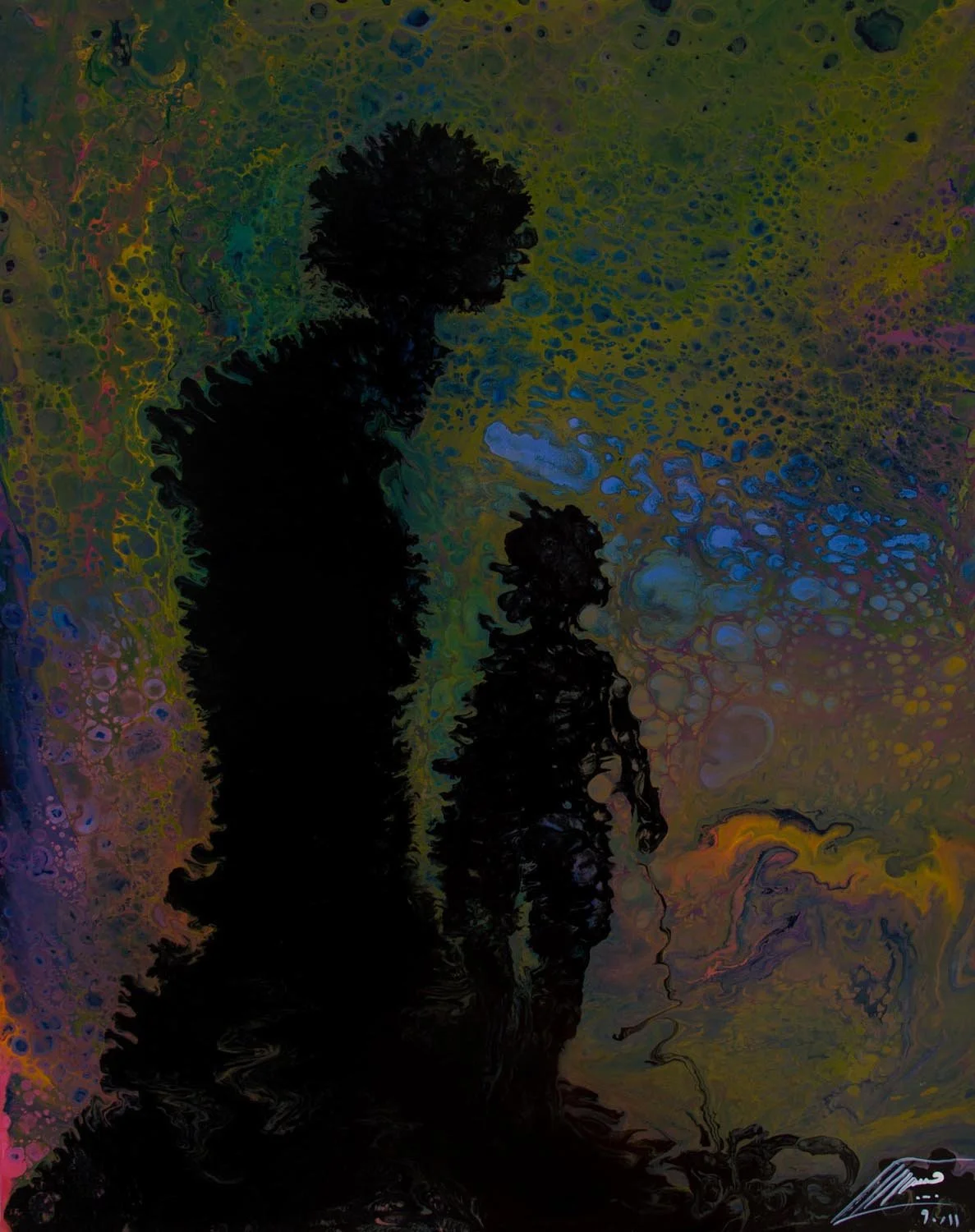
Consider, for example, the development of the followingpainting by Habibe Brumand. As she explains, the work began with a background,onto which she addeda black, rock-like form under the influence of grief. Once realized and perceived, this dark mass intensified the work's melancholy and began to register as a human presence. She then developed the rock into a dark figure. Re-encountering this figure altered what it could mean: it came to signify herself, immersed in a darkness bound to her wound. This recognition prompted the addition of a smaller figure associated with her lost child. Perceiving the two figures together made the loss more salient and deepened the melancholy through which the work was judged, leading her to introduce passages of light blue late in the process. The work's meaning was therefore not fully conceived in advance. Each realized configuration altered what the artist perceived and felt, and those changed conditions guided the next revision.
In the earlier grief-line example, the artist returns to a preserved configuration that grief grades relative to the loss and surrounding work. The line may register as false consolation, premature resolution, disloyalty to the lost attachment, or evasion of the wound's seriousness. This grading carries a valid demand: whatever the work permits must remain faithful to the significance of what was lost. The demand should not be confused with grief's possible closed future, in which fidelity requires meaninglessness forever. Grief does not merely prefer a darker tone. It constrains the continuation by refusing forms of meaning that make grief unnecessary, reduce attachment to an obstacle, or resolve loss through reassurance unsupported by experience. Its contribution remains valid without receiving unilateral authority over the work.
The organization supporting tenderness, continued attachment, or meaningful continuation also grades the line. It may register the configuration as necessary, truthful, alive, or capable of carrying relation beyond closure. This contribution preserves a genuine possibility, but it can become reassuring or evasive if it refuses the weight of loss. The same line is answerable to both references. It may feel tender yet evasive, faithful yet dangerous, necessary yet unearned, or truthful in what it opens but false in how easily it opens. This compound judgment does not synthesize grief and continued meaning. It reveals that both remain consequential and that neither available continuation preserves what the other demands. The artist knows more about the work's problem, but the problem is not compositionally resolved.
Either reference can now produce premature closure. If grief alone determines revision, the artist may delete the line and restore a work where attachment remains truthful only through closure or meaninglessness. Continued possibility disappears before qualifying grief. If the alternative organization alone determines revision, the artist may turn the line into reassurance, making continued meaning possible only by reducing the wound's force. Grief becomes a difficulty to overcome rather than a valid constraint. Both revisions may produce local coherence, emotional force, and formal fluency. Their artistic success in those respects does not remove the compositional exclusion. Each achieves coherence by preventing one relevant reference from remaining consequential, so neither can develop the relation the work has exposed.
The artist instead retains the line's opening while revising its tense, rhythm, syntax, imagery, address, or placement so that continued attachment remains possible without declaring consolation complete. An address to what is absent, for example, can preserve relation while leaving unanswered whether that relation permits a future. A shift from declarative closure to an unfinished syntax can hold the opening without asserting recovery. The resulting configuration remains answerable to the demand for fidelity and to a possible future without fully realizing closure or reassurance. It makes both judgments available for later response. Its ambiguity is materially supported by formal decisions, not by withholding all determination.
For this ambiguity to become consequential, the line must belong formally to the work. Its rhythm, image, syntax, address, tense, or position must relate it to grief-shaped configurations. A recurring image may acquire a different continuation; a rhythm established earlier may be interrupted without being discarded; an altered tense may answer existing temporal patterns. These relations make revision bidirectional: the line changes how earlier passages are encountered, while those passages constrain how its opening can function. Formal organization therefore prevents the new consequence from becoming an isolated hopeful fragment. Grief-generated and possibility-generating consequences become parts of one perceptible development rather than separate statements placed in proximity.
The presence of both gradings and their ambiguous, organized relation establishes consequential joint participation. Reciprocal operation begins if the grief-shaped revision changes what the alternative reference can subsequently produce and the resulting possibility changes how grief later grades and develops the work. The first direction may force tenderness to abandon easy reassurance; the return may allow grief to recognize continued address without treating it as betrayal. Tenderness can acquire a form capable of bearing loss rather than bypassing it, while grief begins permitting a continuation that does not end in closure. Artistic composition develops only as such consequences are preserved, returned, varied, and accumulated, so later exchanges inherit altered conditions. One exchange remains elementary rather than sufficient to establish a developed relation. Formal ambiguity and organization make reciprocity possible; they cannot guarantee its occurrence, accumulation, or adaptive result.
7.3 — Consonist Art as Deliberate Practice
The conditions described so far can arise without a Consonist practice. Artists may externalize consequences produced under different psychological references, preserve them across changes in accessibility, and encounter compound judgments without seeking a reciprocal relation among the participating organizations. Formal ambiguity may sustain an unresolved opposition, protect avoidance, or help a restrictive bond remain coherent. Formal organization may also connect differentiated consequences only until one reference regains control and determines what the work can become. Externalization, persistence, joint participation, and revisability are therefore enabling conditions rather than evidence of a deliberate practice. A specifically Consonist orientation begins when artistic activity is repeatedly organized so that relevant references can leave consequential traces, resistant judgments can return, accumulated consequences can redirect later decisions, and no proposed resolution is protected from what the developing work discloses.
Consonist art is the deliberate artistic cultivation of conditions through which relevant psychological references can participate consequentially in variation and composition, form bonds, and potentially generate a composed reference through consolidation. The definition concerns the organization of artistic activity rather than an aesthetic category. No medium, genre, subject, iconography, technique, or formal appearance is intrinsically Consonist. Figurative or abstract, narrative or nonnarrative, abrasive or serene, fragmented or unified, conventional or experimental work may arise through such a practice, and the same appearances may arise without it. The term does not name a therapeutic genre, identify art about psychology, or certify artistic quality, moral value, psychological health, or successful transformation. It names a process directed toward cultivating composition among references that bear materially upon the developing artistic problem. What distinguishes the practice is not what the work looks like, but how relevant psychological consequences are allowed to enter and reorganize its development.
Deliberate cultivation does not mean that an artist knows the result in advance or can command psychological references to compose. A declared intention to reconcile conflict is insufficient when the artist suppresses resistant consequences, protects a predetermined synthesis, or interprets every returned judgment as support for the chosen result. Deliberateness lies in an operative commitment: the artist repeatedly creates opportunities for relevant references to leave consequences, permits those consequences to return through the work, tests variations, and allows earlier results to alter later action. The commitment concerns references relevant to the artistic problem, not every organization available within the person. It may be embodied in procedures and habits without being explicitly theorized. Because the work can expose exclusions, distortions, or possibilities the original plan did not anticipate, deliberate practice remains corrigible rather than sovereign.
The first governing operation of this practice is fidelity. Fidelity is the preservation of enough of a relevant reference's organizing demands, sensitivities, constraints, and valid functions for its consequences genuinely to affect the developing work. It is causal rather than representational. The artist need not depict the reference, narrate its history, confess an internal state, or allocate it equal visible space. Nor does fidelity require obedience to every configuration or continuation that the reference proposes. A reference participates faithfully when what it preserves can constrain judgment, resist exclusion, alter revision, and change what the work becomes capable of producing. Apparent representation without such consequence is insufficient: a work may describe grief while preventing grief from qualifying its consoling resolution. Conversely, a reference may participate faithfully through rhythm, omission, resistance, or formal demand without becoming the work's recognizable subject.
What fidelity preserves depends upon the compositional task. In corrective composition, fidelity preserves valid functions carried by a restrictive organization without preserving the pathological continuation's authority or requiring the source reference to remain intact. Protection, attachment, responsibility, or recognition of harm must continue to constrain development even when the future to which they became bound is refused. In developmental composition, fidelity preserves the differentiated participation of valid but partial references. None may be rendered causally irrelevant merely to produce coherence, and each must retain the capacity to test what the emerging continuation provides. Fidelity is therefore graded and revisable rather than an initial, all-or-nothing certification. A work may preserve one demand while subtly distorting another, or discover through later feedback that an apparently faithful configuration depended upon exclusion. Fidelity establishes a continuing obligation to consequential participation, not permanent allegiance to a reference's existing form.
Participation must also remain active across the work's accumulating history. Recursive improvisation is artistic activity in which improvisation supplies variation while recursion makes every intervention answerable to the consequences of earlier interventions. An action externalizes a consequence and changes the perceptible field. Later judgment encounters that altered field, and the response changes what subsequent action can do. Improvisation allows departure from predetermined solutions and makes unfamiliar configurations available for testing. Recursion prevents those departures from becoming disconnected novelty: each intervention must answer to what the work already contains, including consequences the artist did not intend or no longer finds convenient. Artistic development thus proceeds through a history that remains open to change without returning to an untouched beginning. Every revision inherits formal relations, exclusions, possibilities, and demands generated by earlier action.
Consider, for example, the development of the following painting by Habibe Brumand. As she explains, the work began with a background, onto which she added a black, rock-like form under the influence of grief. Once realized and perceived, this dark mass intensified the work's melancholy and began to register as a human presence. She then developed the rock into a dark figure. Re-encountering this figure altered what it could mean: it came to signify herself, immersed in a darkness bound to her wound. This recognition prompted the addition of a smaller figure associated with her lost child. Perceiving the two figures together made the loss more salient and deepened the melancholy through which the work was judged, leading her to introduce passages of light blue late in the process. The work's meaning was therefore not fully conceived in advance. Each realized configuration altered what the artist perceived and felt, and those changed conditions guided the next revision.
Recursive improvisation is compatible with planning, preparation, convention, skill, and deliberate technique. A plan can propose a trajectory, and technique can make otherwise unavailable consequences perceptible. Their authority remains conditional upon what the work returns. When an accumulated configuration exposes an excluded demand, reproduces a restriction, or makes an unanticipated possibility relevant, later action must be capable of changing course. Improvisation is therefore neither arbitrary spontaneity nor the absence of formal constraint. Medium-specific resistances, the existing work, artistic judgment, formal organization, and fidelity continually limit what a variation can become. Recursion likewise does not make every earlier choice permanently binding. A configuration can be removed or transformed, but the decision remains answerable to the consequences its presence, alteration, or removal produces. Planning and technique serve an unfolding relation rather than insulating execution from feedback.
Fidelity and recursion do not by themselves supply adaptive direction. Fidelity may preserve a pathological continuation when the artist mistakes it for the valid function fused to it. Recursive improvisation may elaborate avoidance, hostility, hopelessness, reassurance, or another restrictive organization with increasing fluency. Compositional economy and persistence bias remain normatively neutral. An excluding configuration may be readily sustained because it silences a relevant consequence, although it cannot be considered more economical with respect to the same compositional problem merely because it ceases to answer a function that remains materially relevant. Familiarity, established supports, or the absence of developed alternatives may nevertheless give such a configuration a strong persistence bias. Neither coherence, relief, recurrence, emotional intensity, nor formal success establishes adaptive development. Deliberate practice therefore needs a corrigible way to introduce and test departures against present reality, valid function, and the consequences the work returns.
Within artistic practice, selective variation is the deliberate and fallible introduction, preservation, testing, revision, revisiting, or discontinuation of variations in pursuit of more reality-responsive and viable relations. It can alter material, scale, rhythm, timing, syntax, sequence, placement, procedure, viewpoint, intensity, or context. No operation is selectively adaptive in itself; the same formal change may open consequential participation in one configuration and reinforce exclusion in another. Selective variation is not an automatic stage following composition or bond formation. It can intervene whenever a possibility must be introduced, kept available, tested under altered conditions, weakened, or abandoned. It also need not proceed from an explicit verbal rationale. Its direction appears in what the artist chooses to expose to further consequence, while the validity of that choice remains open to revision through later artistic feedback.
Artistic judgment and selective variation consequently perform different tasks. Judgment registers how a possibility is graded relative to an active reference and the developing work. Selective variation changes which possibilities enter the field and receive further development. It may preserve a fragile configuration despite immediate pressure to remove it, revisit an earlier rejection after the work has changed, or discontinue an attractive solution when its fluency is found to depend upon exclusion. In this way, deliberate variation can oppose an established persistence bias. It can keep a less readily sustained possibility available long enough for new affordances and constraints to appear, instead of treating initial difficulty as evidence of irrelevance. This intervention remains fallible. The protected variation may prove sentimental, evasive, destructive, or unrelated to the actual problem, and returned consequences may require its substantial revision or abandonment.
A promising variation may initially increase dissonance or regulatory overhead because it makes an excluded consequence perceptible or disturbs a stable but restrictive organization. Immediate ease is therefore an unreliable criterion of adaptive value. Fidelity, recursive improvisation, and selective variation perform complementary functions. Fidelity protects genuine participation; recursive improvisation makes each development answerable to the accumulated history of the work; selective variation keeps adaptive redirection possible when neutral persistence favors an established restriction. None is sufficient alone, and each remains vulnerable to distortion or error. When their consequences become reciprocal and recur, these operations may cultivate functional interdependence and bond formation. Where the resulting bond develops high reciprocal utility and sufficiently reduced or reorganized recurrent dissonance, it may become consonant; further recurrence and translation may support its eventual consolidation as a composed reference. They cannot manufacture those thresholds, determine when they have been reached, or guarantee that the resulting organization will be adaptive beyond the artistic conditions in which it formed.
In the grief-line example, the artist does not begin with a predetermined synthesis such as the conversion of grief into hope. The deliberate commitment is to keep both relevant organizations consequential and to let their returned effects redirect further development. Fidelity to grief preserves attachment, the significance of the loss, and the demand that any continuation remain answerable to what occurred. It does not preserve the conclusion that no meaningful future is possible. Fidelity to the organization supporting tenderness, endurance, care, or renewed possibility preserves its capacity to sustain continued relation and future-directed action. It does not turn that capacity into optimism, denial, easy reassurance, or a declaration that loss has been resolved. The two references need not receive equal representation. Each must retain enough causal force to change what the next revision can legitimately become.
The artist therefore preserves the difficult line rather than deleting it at the first grief-shaped objection. Its tense, syntax, rhythm, imagery, address, or placement is revised because its opening has registered as too easy. The changed line is then encountered under the organization supporting tenderness or continuation, which may register that grief's correction has restored total closure. A further intervention retains the weight introduced by grief while reopening an address, movement, or unfinished continuation. Each revision answers to consequences already in the work instead of replacing them with an unrelated alternative. Selective variation broadens the test: several tenses or placements may be tried, an earlier version revisited after surrounding passages change, and the line tested beside configurations generated under grief. An aesthetically fluent version may be discontinued when its coherence depends upon reassurance; a more difficult version may be retained provisionally because it keeps both functions consequential.
Deleting the line could immediately reduce conflict and restore the work's established closure. Explicit reassurance could produce an equally rapid resolution. Neither configuration can be considered more economical with respect to the same artistic problem if its fluency depends upon excluding a valid function to which the work must still answer. The artist may therefore preserve the more dissonant possibility while continued testing allows both functions to qualify development. A configuration could emerge in which grief constrains tenderness to remain faithful to the loss, while tenderness enables grief to sustain attachment without requiring a closed future. This reciprocal enablement would constitute a possible developing affordance relation, not evidence that a consonant bond or composed reference has formed. Later feedback may show that tenderness remains sentimental, that fidelity has romanticized suffering, or that ambiguity only postpones a necessary decision. Consonist practice preserves the direction's revisability while cultivating conditions under which a more adequate relation may develop.
7.4 — Translation, Integration, and Limits
A relation cultivated through Consonist art first operates under particular artistic conditions. It may depend upon one work, medium, procedure, sequence of revisions, protected setting, or configuration that preserves consequences in a highly specific way. Even if accumulated reciprocal consequences have produced a consonant bond within that field, the relation may not yet organize another work or artistic circumstance. Local success therefore establishes neither how widely the relation can operate nor how reliably it can return under change. The work may have supplied supports that remain indispensable to its present organization. To avoid treating one artistic achievement as evidence of a general transformation, several scopes must be distinguished according to where the relation recurs, what changes it can survive, and what later activity it can organize.
Intra-domain translation is the preservation and testing of a relation's functional organization across different works, forms, materials, or circumstances within the same artistic practice. Translation does not require reproduction of the original configuration, subject matter, mood, technique, or medium. What must remain operative is the way participating constraints and capacities qualify and enable one another. A relation first developed in writing may therefore be realized through performance, image, sound, or another written work if its functional organization continues to guide what can be perceived, judged, and produced. Changed artistic conditions test whether the relation exceeds the narrow circumstances of its first formation. They also expose which features were incidental and which supports were necessary to sustain the relation.
Surface repetition cannot establish translation. Reusing the same line, image, gesture, atmosphere, or thematic message may reproduce a configuration while the reciprocal relation that organized it no longer operates. Conversely, a visibly different work may translate the relation when the same differentiated functions continue to constrain and enable one another. Successful translation tests the bond beyond its first realization and may strengthen its continuity, but one translation does not establish consolidation or a composed reference. Reference-level capacity requires recurrence through which the relation grades novel possibilities, guides later activity, and preferentially reconstitutes after disturbance. Translation supplies evidence, variation, and developmental testing. It does not by itself prove that the bond has acquired relative operational unity or integrated artistic scope.
Artistic integration is the sufficiently reliable operation of a composed reference within artistic practice. The relation can then grade unfamiliar artistic possibilities, guide later decisions across changing configurations, bring its differentiated constituent functions into participation, and reconstitute after disruption without being rediscovered from the beginning. Artistic integration therefore exceeds a consonant bond formed in one episode or work: the bond must recur, undergo translation, consolidate, and become capable of organizing later artistic activity as a relative unity. This operation remains graded and context-dependent. A composed reference may function reliably in one medium while remaining fragile in another, or across several works while depending upon particular procedures. Artistic integration does not certify artistic quality, formal completion, stylistic unity, psychological health, or emotional harmony. Nor does reliable artistic operation guarantee access beyond artistic practice.
Operation in another domain requires cross-domain translation: the preservation of a composed reference's functional organization as it becomes operative in conduct or another area of life. This is not the transfer of artistic content, reproduction of an artwork's appearance, or imitation of an artistic behavior. A non-artistic field contains different risks, affordances, constraints, materials, and consequences. A relation developed between grief and renewed possibility translates only if loss and future-directed action qualify one another in lived judgment and conduct, not because the person remembers an image or quotes a line. Translation may remain partial or fail when supports such as persistent consequences, protected attention, revisability, temporal distance, or reduced practical risk are absent. Such failure does not invalidate the artistic bond. It reveals the contextual reach and present limits of its organization and may return as feedback without ensuring later success.
Psychological integration is the sufficiently recurrent and accessible operation of a composed reference across the life domains in which it is relevant. It requires inhabitation: the person repeatedly perceives, feels, interprets, judges, chooses, and acts through the organization in lived circumstances. Intellectual endorsement, recollection of an artwork, or one successful performance is insufficient. Relevance bounds the required scope; a composed reference need not organize domains upon which its constituent functions do not materially bear. Integration may also remain uneven. Stress, further loss, environmental change, or altered relationships may reduce accessibility and allow older organizations to reappear. Psychological integration is therefore graded, contextual, and revisable. It means neither cure, permanent emotional harmony, universal accessibility, nor guaranteed adaptiveness. A pathological composed reference can also become widely inhabitable. Integration identifies the scope and reliability of operation, not the value of what operates.
These four distinctions identify scopes of operation rather than mandatory stages on a developmental ladder. Cross-domain translation may occur before a composed reference operates reliably across varied artistic practice. Artistic integration may remain domain-bound without producing substantial change elsewhere. A narrow lived translation may occur in one circumstance without generalizing, while a psychologically consequential relation may begin through an unfinished or formally unsuccessful work. Even where one sequence does move from intra-domain testing to artistic integration and then to broader lived operation, that history does not establish a universal order. Translation can expose weakness, later conditions can narrow access, and recurrence can reopen earlier dissonance. The distinctions rank neither artistic nor psychological achievements. They allow the theory to state more exactly what has become possible, under which conditions, and within what present limits.
Consonist art can support corrective composition by preserving valid functions while adaptive resources qualify a restrictive continuation. It can support developmental composition by keeping valid but partial references jointly consequential while their relation changes. Art is neither necessary nor sufficient for either process. Relationships, clinical settings, sustained dialogue, repeated practices, education, ritual, and other fields can also preserve, return, and coordinate consequences. The artwork remains an enabling field rather than an autonomous psychological agent. Its distinctive contribution is to externalize, preserve, differentiate, return, and make revisable consequences through which a person can continue compositional work across changing accessibility. These capacities can be substantial without becoming guarantees. Art cannot ensure composition, adaptation, bond formation, consolidation, translation, integration, or healing, and artistic success alone does not demonstrate any of those psychological outcomes.
Suppose, conditionally, that accumulated reciprocal consequences in the written work have produced a consonant bond. Grief now constrains renewed possibility to remain faithful to attachment and to the significance of the loss, while renewed possibility enables grief to sustain attachment without requiring a permanently closed future. In a later poem, performance, visual work, or materially different configuration, the original line, imagery, rhythm, and subject are not reproduced. The new work nevertheless remains organized by the same functional relation: possibility cannot erase the loss, and fidelity to loss cannot eliminate every future. This is intra-domain translation. It tests the bond beyond the circumstances of the first work, including the supports supplied by its language and revision history, but it does not yet establish consolidation or artistic integration.
A failed attempt might reveal that the relation depended upon the original work's language, temporal distance, preserved sequence, or particular ambiguity. Repeated successful translations can instead support consolidation. Across later works, the developing relation begins to grade unfamiliar possibilities. It resists consoling configurations that erase the loss and grief-governed configurations that make attachment possible only through permanent closure, while supporting varied formal realizations that preserve their reciprocal constraint and enablement. If it also guides subsequent artistic activity and preferentially reconstitutes after disruption without reconstructing its entire logic, the bond has consolidated as a composed reference. Its sufficiently reliable operation across artistic practice then constitutes artistic integration. The works need not share a style, mood, subject, medium, or degree of formal completion; their continuity lies in the organization through which differentiated functions operate.
A relevant lived circumstance then tests whether that organization can function beyond art. On an anniversary, during a conversation about the deceased, or when deciding whether to re-enter an activity associated with the loss, cross-domain translation does not consist in quoting the poem or following a rule derived from it. It succeeds if the composed reference becomes operative in the situation: the loss remains consequential while continued relation or action becomes possible without betrayal, denial, or premature reassurance. Speaking or remaining silent, preserving an object or giving it away, accepting an invitation or declining it could each realize the same functional relation under different constraints. If the person can sustain that relation only while making art and returns to total closure or false reassurance in conduct, translation has failed or remains partial. One lived realization, however, still does not establish psychological integration.
Psychological integration would require the composed reference to operate recurrently and accessibly across the relevant circumstances in which attachment, loss, and future continuation bear upon what follows. The person may continue to experience grief, pain, conflict, and periods in which the older closed future regains authority. Integration lies in sufficiently reliable inhabitation of the composed reference, not in the disappearance of grief or the achievement of permanent harmony. Artistic integration does not entail this lived scope. The reverse entailment also fails: a psychologically consequential relation may begin through an unfinished or formally unsuccessful work before it reliably organizes later artistic practice. Artistic and psychological achievements must therefore be evaluated independently, even though each can support, test, or disturb the other. These limits return the argument to a broader problem: how psychological life can remain capable of composing again when any achieved organization proves inadequate to changed reality.
Recursive improvisation is compatible with planning, preparation, convention, skill, and deliberate technique. A plan can propose a trajectory, and technique can make otherwise unavailable consequences perceptible. Their authority remains conditional upon what the work returns. When an accumulated configuration exposes an excluded demand, reproduces a restriction, or makes an unanticipated possibility relevant, later action must be capable of changing course. Improvisation is therefore neither arbitrary spontaneity nor the absence of formal constraint. Medium-specific resistances, the existing work, artistic judgment, formal organization, and fidelity continually limit what a variation can become. Recursion likewise does not make every earlier choice permanently binding. A configuration can be removed or transformed, but the decision remains answerable to the consequences its presence, alteration, or removal produces. Planning and technique serve an unfolding relation rather than insulating execution from feedback.
Fidelity and recursion do not by themselves supply adaptive direction. Fidelity may preserve a pathological continuation when the artist mistakes it for the valid function fused to it. Recursive improvisation may elaborate avoidance, hostility, hopelessness, reassurance, or another restrictive organization with increasing fluency. Compositional economy and persistence bias remain normatively neutral. An excluding configuration may be readily sustained because it silences a relevant consequence, although it cannot be considered more economical with respect to the same compositional problem merely because it ceases to answer a function that remains materially relevant. Familiarity, established supports, or the absence of developed alternatives may nevertheless give such a configuration a strong persistence bias. Neither coherence, relief, recurrence, emotional intensity, nor formal success establishes adaptive development. Deliberate practice therefore needs a corrigible way to introduce and test departures against present reality, valid function, and the consequences the work returns.
Within artistic practice, selective variation is the deliberate and fallible introduction, preservation, testing, revision, revisiting, or discontinuation of variations in pursuit of more reality-responsive and viable relations. It can alter material, scale, rhythm, timing, syntax, sequence, placement, procedure, viewpoint, intensity, or context. No operation is selectively adaptive in itself; the same formal change may open consequential participation in one configuration and reinforce exclusion in another. Selective variation is not an automatic stage following composition or bond formation. It can intervene whenever a possibility must be introduced, kept available, tested under altered conditions, weakened, or abandoned. It also need not proceed from an explicit verbal rationale. Its direction appears in what the artist chooses to expose to further consequence, while the validity of that choice remains open to revision through later artistic feedback.
Artistic judgment and selective variation consequently perform different tasks. Judgment registers how a possibility is graded relative to an active reference and the developing work. Selective variation changes which possibilities enter the field and receive further development. It may preserve a fragile configuration despite immediate pressure to remove it, revisit an earlier rejection after the work has changed, or discontinue an attractive solution when its fluency is found to depend upon exclusion. In this way, deliberate variation can oppose an established persistence bias. It can keep a less readily sustained possibility available long enough for new affordances and constraints to appear, instead of treating initial difficulty as evidence of irrelevance. This intervention remains fallible. The protected variation may prove sentimental, evasive, destructive, or unrelated to the actual problem, and returned consequences may require its substantial revision or abandonment.
A promising variation may initially increase dissonance or regulatory overhead because it makes an excluded consequence perceptible or disturbs a stable but restrictive organization. Immediate ease is therefore an unreliable criterion of adaptive value. Fidelity, recursive improvisation, and selective variation perform complementary functions. Fidelity protects genuine participation; recursive improvisation makes each development answerable to the accumulated history of the work; selective variation keeps adaptive redirection possible when neutral persistence favors an established restriction. None is sufficient alone, and each remains vulnerable to distortion or error. When their consequences become reciprocal and recur, these operations may cultivate functional interdependence and bond formation. Where the resulting bond develops high reciprocal utility and sufficiently reduced or reorganized recurrent dissonance, it may become consonant; further recurrence and translation may support its eventual consolidation as a composed reference. They cannot manufacture those thresholds, determine when they have been reached, or guarantee that the resulting organization will be adaptive beyond the artistic conditions in which it formed.
In the grief-line example, the artist does not begin with a predetermined synthesis such as the conversion of grief into hope. The deliberate commitment is to keep both relevant organizations consequential and to let their returned effects redirect further development. Fidelity to grief preserves attachment, the significance of the loss, and the demand that any continuation remain answerable to what occurred. It does not preserve the conclusion that no meaningful future is possible. Fidelity to the organization supporting tenderness, endurance, care, or renewed possibility preserves its capacity to sustain continued relation and future-directed action. It does not turn that capacity into optimism, denial, easy reassurance, or a declaration that loss has been resolved. The two references need not receive equal representation. Each must retain enough causal force to change what the next revision can legitimately become.
The artist therefore preserves the difficult line rather than deleting it at the first grief-shaped objection. Its tense, syntax, rhythm, imagery, address, or placement is revised because its opening has registered as too easy. The changed line is then encountered under the organization supporting tenderness or continuation, which may register that grief's correction has restored total closure. A further intervention retains the weight introduced by grief while reopening an address, movement, or unfinished continuation. Each revision answers to consequences already in the work instead of replacing them with an unrelated alternative. Selective variation broadens the test: several tenses or placements may be tried, an earlier version revisited after surrounding passages change, and the line tested beside configurations generated under grief. An aesthetically fluent version may be discontinued when its coherence depends upon reassurance; a more difficult version may be retained provisionally because it keeps both functions consequential.
Deleting the line could immediately reduce conflict and restore the work's established closure. Explicit reassurance could produce an equally rapid resolution. Neither configuration can be considered more economical with respect to the same artistic problem if its fluency depends upon excluding a valid function to which the work must still answer. The artist may therefore preserve the more dissonant possibility while continued testing allows both functions to qualify development. A configuration could emerge in which grief constrains tenderness to remain faithful to the loss, while tenderness enables grief to sustain attachment without requiring a closed future. This reciprocal enablement would constitute a possible developing affordance relation, not evidence that a consonant bond or composed reference has formed. Later feedback may show that tenderness remains sentimental, that fidelity has romanticized suffering, or that ambiguity only postpones a necessary decision. Consonist practice preserves the direction's revisability while cultivating conditions under which a more adequate relation may develop.
7.4 — Translation, Integration, and Limits
A relation cultivated through Consonist art first operates under particular artistic conditions. It may depend upon one work, medium, procedure, sequence of revisions, protected setting, or configuration that preserves consequences in a highly specific way. Even if accumulated reciprocal consequences have produced a consonant bond within that field, the relation may not yet organize another work or artistic circumstance. Local success therefore establishes neither how widely the relation can operate nor how reliably it can return under change. The work may have supplied supports that remain indispensable to its present organization. To avoid treating one artistic achievement as evidence of a general transformation, several scopes must be distinguished according to where the relation recurs, what changes it can survive, and what later activity it can organize.
Intra-domain translation is the preservation and testing of a relation's functional organization across different works, forms, materials, or circumstances within the same artistic practice. Translation does not require reproduction of the original configuration, subject matter, mood, technique, or medium. What must remain operative is the way participating constraints and capacities qualify and enable one another. A relation first developed in writing may therefore be realized through performance, image, sound, or another written work if its functional organization continues to guide what can be perceived, judged, and produced. Changed artistic conditions test whether the relation exceeds the narrow circumstances of its first formation. They also expose which features were incidental and which supports were necessary to sustain the relation.
Surface repetition cannot establish translation. Reusing the same line, image, gesture, atmosphere, or thematic message may reproduce a configuration while the reciprocal relation that organized it no longer operates. Conversely, a visibly different work may translate the relation when the same differentiated functions continue to constrain and enable one another. Successful translation tests the bond beyond its first realization and may strengthen its continuity, but one translation does not establish consolidation or a composed reference. Reference-level capacity requires recurrence through which the relation grades novel possibilities, guides later activity, and preferentially reconstitutes after disturbance. Translation supplies evidence, variation, and developmental testing. It does not by itself prove that the bond has acquired relative operational unity or integrated artistic scope.
Artistic integration is the sufficiently reliable operation of a composed reference within artistic practice. The relation can then grade unfamiliar artistic possibilities, guide later decisions across changing configurations, bring its differentiated constituent functions into participation, and reconstitute after disruption without being rediscovered from the beginning. Artistic integration therefore exceeds a consonant bond formed in one episode or work: the bond must recur, undergo translation, consolidate, and become capable of organizing later artistic activity as a relative unity. This operation remains graded and context-dependent. A composed reference may function reliably in one medium while remaining fragile in another, or across several works while depending upon particular procedures. Artistic integration does not certify artistic quality, formal completion, stylistic unity, psychological health, or emotional harmony. Nor does reliable artistic operation guarantee access beyond artistic practice.
Operation in another domain requires cross-domain translation: the preservation of a composed reference's functional organization as it becomes operative in conduct or another area of life. This is not the transfer of artistic content, reproduction of an artwork's appearance, or imitation of an artistic behavior. A non-artistic field contains different risks, affordances, constraints, materials, and consequences. A relation developed between grief and renewed possibility translates only if loss and future-directed action qualify one another in lived judgment and conduct, not because the person remembers an image or quotes a line. Translation may remain partial or fail when supports such as persistent consequences, protected attention, revisability, temporal distance, or reduced practical risk are absent. Such failure does not invalidate the artistic bond. It reveals the contextual reach and present limits of its organization and may return as feedback without ensuring later success.
Psychological integration is the sufficiently recurrent and accessible operation of a composed reference across the life domains in which it is relevant. It requires inhabitation: the person repeatedly perceives, feels, interprets, judges, chooses, and acts through the organization in lived circumstances. Intellectual endorsement, recollection of an artwork, or one successful performance is insufficient. Relevance bounds the required scope; a composed reference need not organize domains upon which its constituent functions do not materially bear. Integration may also remain uneven. Stress, further loss, environmental change, or altered relationships may reduce accessibility and allow older organizations to reappear. Psychological integration is therefore graded, contextual, and revisable. It means neither cure, permanent emotional harmony, universal accessibility, nor guaranteed adaptiveness. A pathological composed reference can also become widely inhabitable. Integration identifies the scope and reliability of operation, not the value of what operates.
These four distinctions identify scopes of operation rather than mandatory stages on a developmental ladder. Cross-domain translation may occur before a composed reference operates reliably across varied artistic practice. Artistic integration may remain domain-bound without producing substantial change elsewhere. A narrow lived translation may occur in one circumstance without generalizing, while a psychologically consequential relation may begin through an unfinished or formally unsuccessful work. Even where one sequence does move from intra-domain testing to artistic integration and then to broader lived operation, that history does not establish a universal order. Translation can expose weakness, later conditions can narrow access, and recurrence can reopen earlier dissonance. The distinctions rank neither artistic nor psychological achievements. They allow the theory to state more exactly what has become possible, under which conditions, and within what present limits.
Consonist art can support corrective composition by preserving valid functions while adaptive resources qualify a restrictive continuation. It can support developmental composition by keeping valid but partial references jointly consequential while their relation changes. Art is neither necessary nor sufficient for either process. Relationships, clinical settings, sustained dialogue, repeated practices, education, ritual, and other fields can also preserve, return, and coordinate consequences. The artwork remains an enabling field rather than an autonomous psychological agent. Its distinctive contribution is to externalize, preserve, differentiate, return, and make revisable consequences through which a person can continue compositional work across changing accessibility. These capacities can be substantial without becoming guarantees. Art cannot ensure composition, adaptation, bond formation, consolidation, translation, integration, or healing, and artistic success alone does not demonstrate any of those psychological outcomes.
Suppose, conditionally, that accumulated reciprocal consequences in the written work have produced a consonant bond. Grief now constrains renewed possibility to remain faithful to attachment and to the significance of the loss, while renewed possibility enables grief to sustain attachment without requiring a permanently closed future. In a later poem, performance, visual work, or materially different configuration, the original line, imagery, rhythm, and subject are not reproduced. The new work nevertheless remains organized by the same functional relation: possibility cannot erase the loss, and fidelity to loss cannot eliminate every future. This is intra-domain translation. It tests the bond beyond the circumstances of the first work, including the supports supplied by its language and revision history, but it does not yet establish consolidation or artistic integration.
A failed attempt might reveal that the relation depended upon the original work's language, temporal distance, preserved sequence, or particular ambiguity. Repeated successful translations can instead support consolidation. Across later works, the developing relation begins to grade unfamiliar possibilities. It resists consoling configurations that erase the loss and grief-governed configurations that make attachment possible only through permanent closure, while supporting varied formal realizations that preserve their reciprocal constraint and enablement. If it also guides subsequent artistic activity and preferentially reconstitutes after disruption without reconstructing its entire logic, the bond has consolidated as a composed reference. Its sufficiently reliable operation across artistic practice then constitutes artistic integration. The works need not share a style, mood, subject, medium, or degree of formal completion; their continuity lies in the organization through which differentiated functions operate.
A relevant lived circumstance then tests whether that organization can function beyond art. On an anniversary, during a conversation about the deceased, or when deciding whether to re-enter an activity associated with the loss, cross-domain translation does not consist in quoting the poem or following a rule derived from it. It succeeds if the composed reference becomes operative in the situation: the loss remains consequential while continued relation or action becomes possible without betrayal, denial, or premature reassurance. Speaking or remaining silent, preserving an object or giving it away, accepting an invitation or declining it could each realize the same functional relation under different constraints. If the person can sustain that relation only while making art and returns to total closure or false reassurance in conduct, translation has failed or remains partial. One lived realization, however, still does not establish psychological integration.
Psychological integration would require the composed reference to operate recurrently and accessibly across the relevant circumstances in which attachment, loss, and future continuation bear upon what follows. The person may continue to experience grief, pain, conflict, and periods in which the older closed future regains authority. Integration lies in sufficiently reliable inhabitation of the composed reference, not in the disappearance of grief or the achievement of permanent harmony. Artistic integration does not entail this lived scope. The reverse entailment also fails: a psychologically consequential relation may begin through an unfinished or formally unsuccessful work before it reliably organizes later artistic practice. Artistic and psychological achievements must therefore be evaluated independently, even though each can support, test, or disturb the other. These limits return the argument to a broader problem: how psychological life can remain capable of composing again when any achieved organization proves inadequate to changed reality.