
The Evolution
of Consonism
A Sorrowful Gaze That Remains Alive
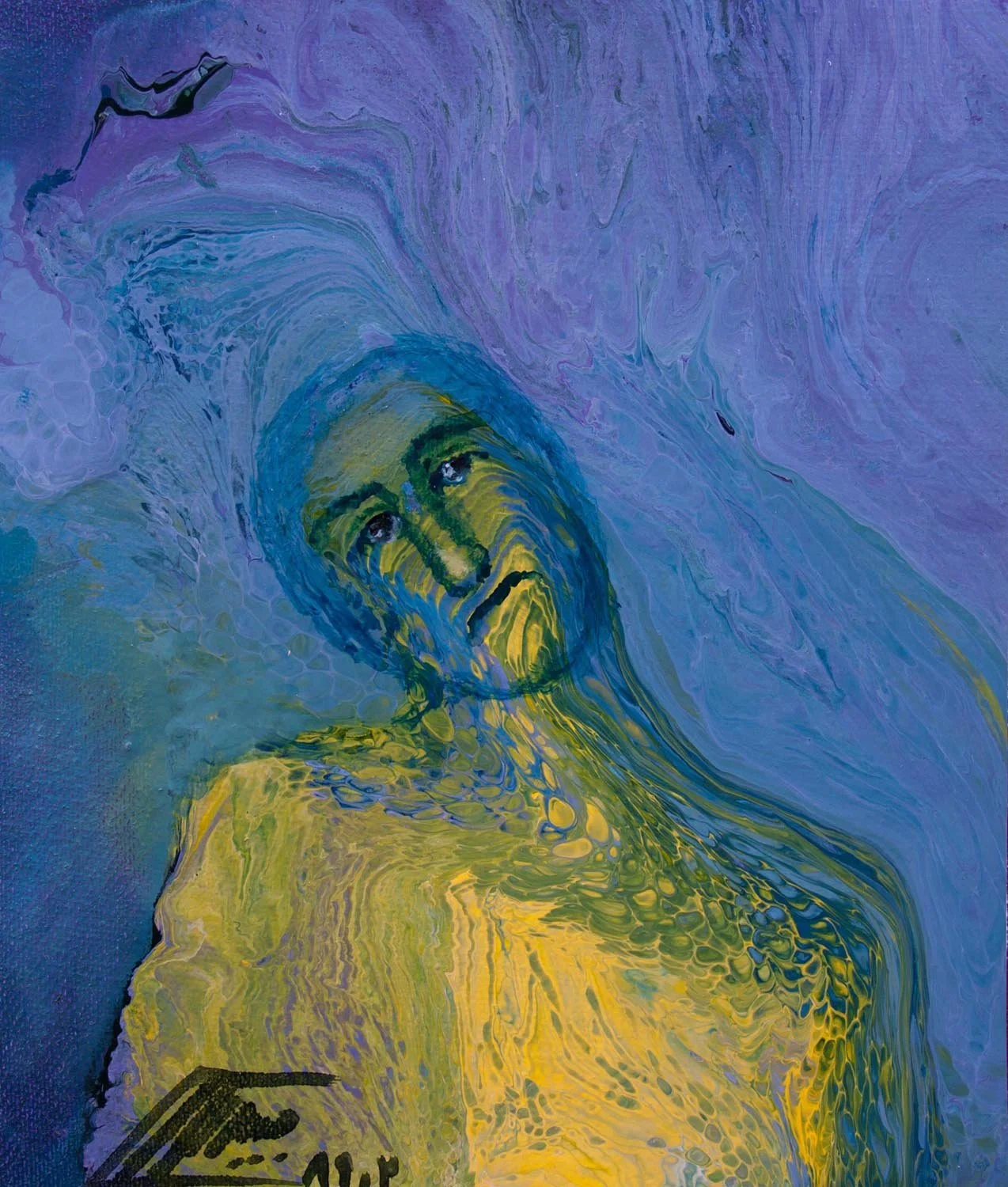
Grief introduces a palette of violet and blue to the surface, where fluid paint shifts as Brumand tilts the canvas. Each movement alters the field without fixing its final form. Deliberate yet indeterminate, the process unfolds through a continuous exchange between intention and discovery.
Warm accents of yellow enter the composition, carrying sparks of hope. Brumand redirects the flow, using a painting knife to manifest the emerging image. A human figure gradually appears—first the body, then the head—where blue and yellow move into close relation and the face comes into focus. Here, each color performs a distinct function: blue preserves the weight of grief, while yellow sustains life and the possibility of hope.
As the painting develops, the two colors become functionally interdependent, each altering how the other operates. Yellow prevents grief from dominating the canvas and claiming sole interpretation, while blue anchors hope to the reality of pain—preventing it from becoming a reassurance that abandons the wound. By leveraging one another’s affordances and minimizing their mismatch, hope and grief enter a consonant relation that accomplishes what neither emotion could achieve in isolation, resolving in a gaze that is deeply sorrowful, yet alive.
The Evolution of Brumand’s Art and Consonism
The Evolution of Brumand’s Art and Consonism
A Sorrowful Gaze That Remains Alive
Grief introduces violet and blue to the surface, where fluid paint shifts as Brumand tilts the support. Each movement changes the field without fixing its final form. An edge gathers, a curve opens, colors meet, and what appears alters what she can see and do next. Brumand guides the process by establishing its conditions, attending to the results, and responding through another intervention. The painting develops through this exchange between intention and discovery: the material return changes the next judgment, and the next judgment changes the material field again.
Yellow enters the violet-blue field as a fragile possibility of hope. Brumand redirects the flow by tilting the support, then uses a painting knife to preserve an edge or hold an emerging configuration long enough for its possibilities to become visible. A human figure gradually forms—first the body, then the head, where blue and yellow move into close relation and the face comes into focus. Recognition changes the work. Once Brumand sees a face, its expression alters her emotional response and the actions the painting now seems to require. The figure is inseparable from the history that produced it: movement, attention, intervention, recognition, and return.
Within this painting, blue preserves grief and keeps the image answerable to loss. Yellow preserves life and possible continuation. Each color changes what the other can express: blue prevents hope from becoming a reassurance that abandons the wound, while yellow prevents grief from claiming the entire future of the image. Their relation gathers in a gaze that is deeply sorrowful, yet alive. Neither contribution could produce the same expression alone. This mature event belongs to the practice later called Consonism, in which distinct psychological realities acquire material consequence and develop new expressive capacities through one another. Its name comes after the practice. The history begins with the experiences that taught Brumand to explore freely while remaining faithful to what reality returned.
Freedom Becomes Answerable to Reality
Brumand traces the earliest basis of her art to a way of attending rather than to a recognizable style. Childhood encounters with the old bazaar and the natural world trained her to notice movement, changing relations, and forms that became visible through sustained looking. She later summarized the orientation as a commitment to explore freely while remaining truthful to the reality from which exploration began. Freedom meant testing a possibility; reality retained the authority to correct it. This relation between openness and consequence became more important than any specific childhood image. It established the practical discipline through which Brumand would later approach observation, material experiment, and emotional experience.
The same concern shaped her decision to decline a place at a fine-arts college. Brumand feared that an established visual language, adopted before her own had developed, would stand between perception and the force that first made her want to paint. She was protecting an unfinished language, rather than rejecting knowledge or technique. Independent study placed greater weight on observation, repetition, dissatisfaction, material feedback, and failure. The work itself had to expose what was vague, careless, or formally weak. By the time she began painting portraits and landscapes at about sixteen, freedom already carried an obligation: every departure had to remain answerable to the subject and to the consequences visible on the surface.
Beyond Realism, While Form Still Governs
Realism gave Brumand’s fidelity its first developed visual discipline. Meticulous detail, recognizable proportion, perspective, balance, and spatial organization kept the image accountable to what she observed. Technique served the living subject; it allowed a face or landscape to survive the passage into paint with its defining relations intact. This formal training remained essential to everything that followed, because later distortion and abstraction drew their precision from capacities already acquired through representation.
Over time, Brumand discovered that literal detail and fidelity were different. She could reduce descriptive information while preserving the relations that made a subject coherent. Perspective, balance, and spatial structure continued to organize the work even as surface likeness diminished. Abstraction therefore developed within her realist discipline. A deeper encounter with the subject revealed more exactly what the painting needed to preserve, and that precision allowed nonessential constraints to be released. Freedom expanded because fidelity had become more exact.
This discovery established a major pattern in Brumand’s development. Each deeper encounter with reality changed what fidelity required; once the essential demand became clearer, forms that obstructed it could loosen. Abstraction enlarged her repertoire without replacing representation, and formal knowledge remained available across later modes. At this point, however, form still governed what counted as a truthful painting. The years beside her son Doman introduced realities in which emotion, responsibility, uncertainty, and action mattered more than visible form. They required fidelity to move beyond visible correspondence.
When Emotion Took Command
Doman’s profound disabilities confronted Brumand with a practical problem for which love supplied commitment but no complete method. Early assessments described severe limits, while daily life continued to return responses that could be observed, tested, and developed. Brumand broke large aims such as movement, speech, reading, and writing into smaller capacities; she learned from professional knowledge, adapted it, and allowed Doman’s effort and responses to guide revision. Creativity acquired a demanding meaning: the search for a viable continuation when established methods were insufficient. Possibility could precede proof because it remained joined to work, observation, and correction. Years later, Doman walked, spoke, read, and wrote while continuing to live with profound disability and need for support.
The household also contained other children and other emotional realities. Anxiety, exhaustion, and repeated setbacks existed beside play, tenderness, happiness, and the needs of lives that could not be reduced to Doman’s urgency. Brumand painted at night, after the work of care, creating a space in which her own emotional life could remain active. She describes this practice as helping her return to responsibility with greater steadiness. Scarcity widened her material freedom: when canvas was unavailable, she worked on copper, radiographic film, worn leather, cardboard, pastry boxes, and other discarded surfaces. Painting became both inward necessity and practical experiment.
These years changed the object of fidelity. Emotional experience was no longer material to be fitted inside an inherited form; it became part of the reality by which form was judged. The emotions governing a painting arrived as more than isolated feelings. They belonged to wider organizations of perception, memory, meaning, expectation, and possible action. Consonism later calls such a relatively stable organization a psychological reference, or simply a reference, because it provides an organizing basis against which present experience and possible continuations are assessed. A reference gives experience continuity by grading present experience against its constraints: it shapes what a person notices, what appears credible or necessary, and what can be felt or done next. It can admit several responses while giving them a common orientation. When this article speaks of a grief-shaped or hope-shaped reference, it therefore means the wider organization operating through that emotion. Perspective, balance, and structured spatial relations remained available, but Brumand strained or suspended them when they obstructed the emotional organization the painting needed to preserve. Emotion took command through judgment, and formal authority became conditional upon emotional truth.
Brumand often entered an absorbed, meditative working state, supported by classical music that corresponded to the emotional field. In this state, judgment remained active through feeling and embodied action. She retained, revised, rejected, emphasized, or repeated a passage according to whether it remained faithful to the reference then shaping her encounter with the work. Each decision left a visible consequence on the support. When another reference became accessible, the earlier consequence remained and entered the conditions of the next decision. A painting therefore accumulated as a history of feeling, judgment, action, and renewed encounter.
As Brumand painted from more than one reference within the same surface, the first Consonist relations formed. Co-influence makes distinct references active in one developing field: each shapes judgment and leaves consequences the other can later encounter. A grief-shaped decision may establish darkness, weight, or closure; a later contribution shaped by tenderness or hope must work within that inherited field and leave consequences of its own. Reciprocal consequence begins when the influence returns. Grief changes what hope can express, and hope’s altered expression then changes what grief can mean or produce. When these exchanges are preserved and accumulate, they form composition in the Consonist sense: a developing history in which each intervention inherits earlier consequences and alters the conditions of what follows. This meaning differs from the visual arrangement of a finished image. During the Doman years, the history remained fragile, but Brumand attributes an important corrective role to it. Across the following decade, emotional fidelity, persistent consequence, and early composition prepared a practice that could preserve several pressures within one work. Zoya’s death would expose the limits of that practice.
The Break in Painting and the Passage Through Words
Zoya died at nineteen. The loss severed Brumand’s access to the artistic relations that had previously sustained her. Nature and music remained present but no longer carried their former meaning; color belonged to a language she could not enter. Grief became the condition within which thought occurred, and movement toward life felt like disloyalty to Zoya’s absence. The early compositional practice of the Doman years had been real, yet its relations were too weakly accumulated to carry this rupture. Painting stopped.
Words provided a narrower form of continuity. One word could stand beside another, and one sentence could follow the previous one, allowing Brumand to approach part of the grief when its whole could not be held at once. Writing created a place within the loss rather than a path beyond it. She wrote, stopped, questioned, and returned, without identifying one decisive turning point. Repetition preserved enough relation for another sentence to become possible.
Brumand recalls that words gradually made room for color. Their sequence reopened the possibility of combination, but the earlier painting practice could not simply resume. She needed a field capable of preserving overwhelming emotion while remaining open to movement, deformation, and unfamiliar relation. The return began without a finished image: fluid color could move before Brumand knew what the painting, or the life surrounding it, should become. A psychological rupture had become a material problem.
Developing a Medium That Could Move
The first paintings after Brumand’s return were predominantly black, dark, and painful. Internally, grief felt without boundary; on the surface, a consequence formed under its influence acquired color, density, direction, edge, and duration. Brumand could approach the work, leave it, and return under another state of attention. The painting preserved an encounter that would otherwise have disappeared with the moment that produced it. Pain became materially present and revisable, changing Brumand’s position within what she suffered while leaving the reality of the loss intact.
This new artistic task required a precise material behavior. Paint had to move freely enough to disclose configurations Brumand could not design in advance, while preserving local chromatic relations through substantial deformation. The surface needed to remain workable long enough for her to perceive what had emerged, judge it, and intervene. Drying then had to preserve selected consequences so later actions could build upon them. The problem joined mobility, differentiation, working time, and material memory in one system.
Brumand developed that system through comparative trials. She tested several types of paint and selected metallic paint as the most suitable base. She compared solvents, chose petroleum, and adjusted its proportion until viscosity and drying time became practically controllable. The calibrated mixture created an interval in which paint could flow semi-freely, collide, stretch, and bend while remaining open to intervention. Her technical innovation lay in coordinating existing materials around the behavior her practice required.
Support trials completed the system. Brumand selected medium-density fiberboard (MDF) and X-ray film because their surfaces sustained the movement and working interval she sought. Radiographic film had appeared earlier among the materials she reused when canvas was scarce; it now became a deliberate component of a coordinated method. Paint, solvent, proportion, support, and procedure worked together, and different later works could draw selectively from that system. The medium was distinctive because of the relation Brumand developed among its parts.
The result was calibrated unpredictability. Brumand controlled the initial colors, viscosity, support, direction of tilt, and timing of intervention, while exact local configurations emerged through flow and collision. Tilting redirected the field; a painting knife preserved an edge, divided or joined regions, and changed the continuation of a form. These actions translated judgment into material change. Brumand encountered what the paint had produced, decided which possibility mattered, and altered the conditions again. Large structures could deform while local color relations remained recognizable enough to continue shaping the work.
Brumand’s initial palettes arose from the emotional field of each painting. Because their local relations survived movement, differently organized emotions could leave distinguishable chromatic consequences within the same surface. In Consonist terms, a function is the contribution a reference makes to the developing process: what it registers, preserves, constrains, or makes possible. In the early post-Zoya works, grief preserved attachment, memory, and the reality of Zoya’s absence. Lighter passages sometimes made another function perceptible before Brumand could consciously accept it, carrying the possibility of continuation. She kept them within the dark field and allowed grief to test whether their promise was truthful. Hope needed grief to prevent continuation from becoming an evasion of loss, while grief needed a credible continuation to release the future from total closure. Color gave these functions a material form that could remain present long enough for their relation to develop.
The persistent surface made these encounters available across changing emotional states. A configuration formed under grief remained perceptible when hope or compassion later became accessible; their response then altered what grief encountered on return. As this exchange recurred, co-influence became durable, reciprocal consequences accumulated, and composition developed into a shared material history rather than a momentary encounter. The repeated exchange also produced early functional reliance: each reference began accomplishing part of its role through conditions supplied by the other. Hope drew truthfulness from grief, while grief drew future-opening capacity from hope and compassion. A threshold work in the ordered sequence makes the new artistic range visible through fluid deformation, tree-like and landscape relations, ambiguous form, and increasing figuration. The developed medium had become capable of preserving difference through change and allowing the work’s own consequences to guide its continuation.
Freedom Becomes Answerable to Reality
Brumand traces the earliest basis of her art to a way of attending rather than to a recognizable style. Childhood encounters with the old bazaar and the natural world trained her to notice movement, changing relations, and forms that became visible through sustained looking. She later summarized the orientation as a commitment to explore freely while remaining truthful to the reality from which exploration began. Freedom meant testing a possibility; reality retained the authority to correct it. This relation between openness and consequence became more important than any specific childhood image. It established the practical discipline through which Brumand would later approach observation, material experiment, and emotional experience.
The same concern shaped her decision to decline a place at a fine-arts college. Brumand feared that an established visual language, adopted before her own had developed, would stand between perception and the force that first made her want to paint. She was protecting an unfinished language, rather than rejecting knowledge or technique. Independent study placed greater weight on observation, repetition, dissatisfaction, material feedback, and failure. The work itself had to expose what was vague, careless, or formally weak. By the time she began painting portraits and landscapes at about sixteen, freedom already carried an obligation: every departure had to remain answerable to the subject and to the consequences visible on the surface.
Beyond Realism, While Form Still Governs
Realism gave Brumand’s fidelity its first developed visual discipline. Meticulous detail, recognizable proportion, perspective, balance, and spatial organization kept the image accountable to what she observed. Technique served the living subject; it allowed a face or landscape to survive the passage into paint with its defining relations intact. This formal training remained essential to everything that followed, because later distortion and abstraction drew their precision from capacities already acquired through representation.
Over time, Brumand discovered that literal detail and fidelity were different. She could reduce descriptive information while preserving the relations that made a subject coherent. Perspective, balance, and spatial structure continued to organize the work even as surface likeness diminished. Abstraction therefore developed within her realist discipline. A deeper encounter with the subject revealed more exactly what the painting needed to preserve, and that precision allowed nonessential constraints to be released. Freedom expanded because fidelity had become more exact.
This discovery established a major pattern in Brumand’s development. Each deeper encounter with reality changed what fidelity required; once the essential demand became clearer, forms that obstructed it could loosen. Abstraction enlarged her repertoire without replacing representation, and formal knowledge remained available across later modes. At this point, however, form still governed what counted as a truthful painting. The years beside her son Doman introduced realities in which emotion, responsibility, uncertainty, and action mattered more than visible form. They required fidelity to move beyond visible correspondence.
When Emotion Took Command
Doman’s profound disabilities confronted Brumand with a practical problem for which love supplied commitment but no complete method. Early assessments described severe limits, while daily life continued to return responses that could be observed, tested, and developed. Brumand broke large aims such as movement, speech, reading, and writing into smaller capacities; she learned from professional knowledge, adapted it, and allowed Doman’s effort and responses to guide revision. Creativity acquired a demanding meaning: the search for a viable continuation when established methods were insufficient. Possibility could precede proof because it remained joined to work, observation, and correction. Years later, Doman walked, spoke, read, and wrote while continuing to live with profound disability and need for support.
The household also contained other children and other emotional realities. Anxiety, exhaustion, and repeated setbacks existed beside play, tenderness, happiness, and the needs of lives that could not be reduced to Doman’s urgency. Brumand painted at night, after the work of care, creating a space in which her own emotional life could remain active. She describes this practice as helping her return to responsibility with greater steadiness. Scarcity widened her material freedom: when canvas was unavailable, she worked on copper, radiographic film, worn leather, cardboard, pastry boxes, and other discarded surfaces. Painting became both inward necessity and practical experiment.
These years changed the object of fidelity. Emotional experience was no longer material to be fitted inside an inherited form; it became part of the reality by which form was judged. The emotions governing a painting arrived as more than isolated feelings. They belonged to wider organizations of perception, memory, meaning, expectation, and possible action. Consonism later calls such a relatively stable organization a psychological reference, or simply a reference, because it provides an organizing basis against which present experience and possible continuations are assessed. A reference gives experience continuity by grading present experience against its constraints: it shapes what a person notices, what appears credible or necessary, and what can be felt or done next. It can admit several responses while giving them a common orientation. When this article speaks of a grief-shaped or hope-shaped reference, it therefore means the wider organization operating through that emotion. Perspective, balance, and structured spatial relations remained available, but Brumand strained or suspended them when they obstructed the emotional organization the painting needed to preserve. Emotion took command through judgment, and formal authority became conditional upon emotional truth.
Brumand often entered an absorbed, meditative working state, supported by classical music that corresponded to the emotional field. In this state, judgment remained active through feeling and embodied action. She retained, revised, rejected, emphasized, or repeated a passage according to whether it remained faithful to the reference then shaping her encounter with the work. Each decision left a visible consequence on the support. When another reference became accessible, the earlier consequence remained and entered the conditions of the next decision. A painting therefore accumulated as a history of feeling, judgment, action, and renewed encounter.
As Brumand painted from more than one reference within the same surface, the first Consonist relations formed. Co-influence makes distinct references active in one developing field: each shapes judgment and leaves consequences the other can later encounter. A grief-shaped decision may establish darkness, weight, or closure; a later contribution shaped by tenderness or hope must work within that inherited field and leave consequences of its own. Reciprocal consequence begins when the influence returns. Grief changes what hope can express, and hope’s altered expression then changes what grief can mean or produce. When these exchanges are preserved and accumulate, they form composition in the Consonist sense: a developing history in which each intervention inherits earlier consequences and alters the conditions of what follows. This meaning differs from the visual arrangement of a finished image. During the Doman years, the history remained fragile, but Brumand attributes an important corrective role to it. Across the following decade, emotional fidelity, persistent consequence, and early composition prepared a practice that could preserve several pressures within one work. Zoya’s death would expose the limits of that practice.
The Break in Painting and the Passage Through Words
Zoya died at nineteen. The loss severed Brumand’s access to the artistic relations that had previously sustained her. Nature and music remained present but no longer carried their former meaning; color belonged to a language she could not enter. Grief became the condition within which thought occurred, and movement toward life felt like disloyalty to Zoya’s absence. The early compositional practice of the Doman years had been real, yet its relations were too weakly accumulated to carry this rupture. Painting stopped.
Words provided a narrower form of continuity. One word could stand beside another, and one sentence could follow the previous one, allowing Brumand to approach part of the grief when its whole could not be held at once. Writing created a place within the loss rather than a path beyond it. She wrote, stopped, questioned, and returned, without identifying one decisive turning point. Repetition preserved enough relation for another sentence to become possible.
Brumand recalls that words gradually made room for color. Their sequence reopened the possibility of combination, but the earlier painting practice could not simply resume. She needed a field capable of preserving overwhelming emotion while remaining open to movement, deformation, and unfamiliar relation. The return began without a finished image: fluid color could move before Brumand knew what the painting, or the life surrounding it, should become. A psychological rupture had become a material problem.
Developing a Medium That Could Move
The first paintings after Brumand’s return were predominantly black, dark, and painful. Internally, grief felt without boundary; on the surface, a consequence formed under its influence acquired color, density, direction, edge, and duration. Brumand could approach the work, leave it, and return under another state of attention. The painting preserved an encounter that would otherwise have disappeared with the moment that produced it. Pain became materially present and revisable, changing Brumand’s position within what she suffered while leaving the reality of the loss intact.
This new artistic task required a precise material behavior. Paint had to move freely enough to disclose configurations Brumand could not design in advance, while preserving local chromatic relations through substantial deformation. The surface needed to remain workable long enough for her to perceive what had emerged, judge it, and intervene. Drying then had to preserve selected consequences so later actions could build upon them. The problem joined mobility, differentiation, working time, and material memory in one system.
Brumand developed that system through comparative trials. She tested several types of paint and selected metallic paint as the most suitable base. She compared solvents, chose petroleum, and adjusted its proportion until viscosity and drying time became practically controllable. The calibrated mixture created an interval in which paint could flow semi-freely, collide, stretch, and bend while remaining open to intervention. Her technical innovation lay in coordinating existing materials around the behavior her practice required.
Support trials completed the system. Brumand selected medium-density fiberboard (MDF) and X-ray film because their surfaces sustained the movement and working interval she sought. Radiographic film had appeared earlier among the materials she reused when canvas was scarce; it now became a deliberate component of a coordinated method. Paint, solvent, proportion, support, and procedure worked together, and different later works could draw selectively from that system. The medium was distinctive because of the relation Brumand developed among its parts.
The result was calibrated unpredictability. Brumand controlled the initial colors, viscosity, support, direction of tilt, and timing of intervention, while exact local configurations emerged through flow and collision. Tilting redirected the field; a painting knife preserved an edge, divided or joined regions, and changed the continuation of a form. These actions translated judgment into material change. Brumand encountered what the paint had produced, decided which possibility mattered, and altered the conditions again. Large structures could deform while local color relations remained recognizable enough to continue shaping the work.
Brumand’s initial palettes arose from the emotional field of each painting. Because their local relations survived movement, differently organized emotions could leave distinguishable chromatic consequences within the same surface. In Consonist terms, a function is the contribution a reference makes to the developing process: what it registers, preserves, constrains, or makes possible. In the early post-Zoya works, grief preserved attachment, memory, and the reality of Zoya’s absence. Lighter passages sometimes made another function perceptible before Brumand could consciously accept it, carrying the possibility of continuation. She kept them within the dark field and allowed grief to test whether their promise was truthful. Hope needed grief to prevent continuation from becoming an evasion of loss, while grief needed a credible continuation to release the future from total closure. Color gave these functions a material form that could remain present long enough for their relation to develop.
The persistent surface made these encounters available across changing emotional states. A configuration formed under grief remained perceptible when hope or compassion later became accessible; their response then altered what grief encountered on return. As this exchange recurred, co-influence became durable, reciprocal consequences accumulated, and composition developed into a shared material history rather than a momentary encounter. The repeated exchange also produced early functional reliance: each reference began accomplishing part of its role through conditions supplied by the other. Hope drew truthfulness from grief, while grief drew future-opening capacity from hope and compassion. A threshold work in the ordered sequence makes the new artistic range visible through fluid deformation, tree-like and landscape relations, ambiguous form, and increasing figuration. The developed medium had become capable of preserving difference through change and allowing the work’s own consequences to guide its continuation.
When the Painting Began to Answer Back
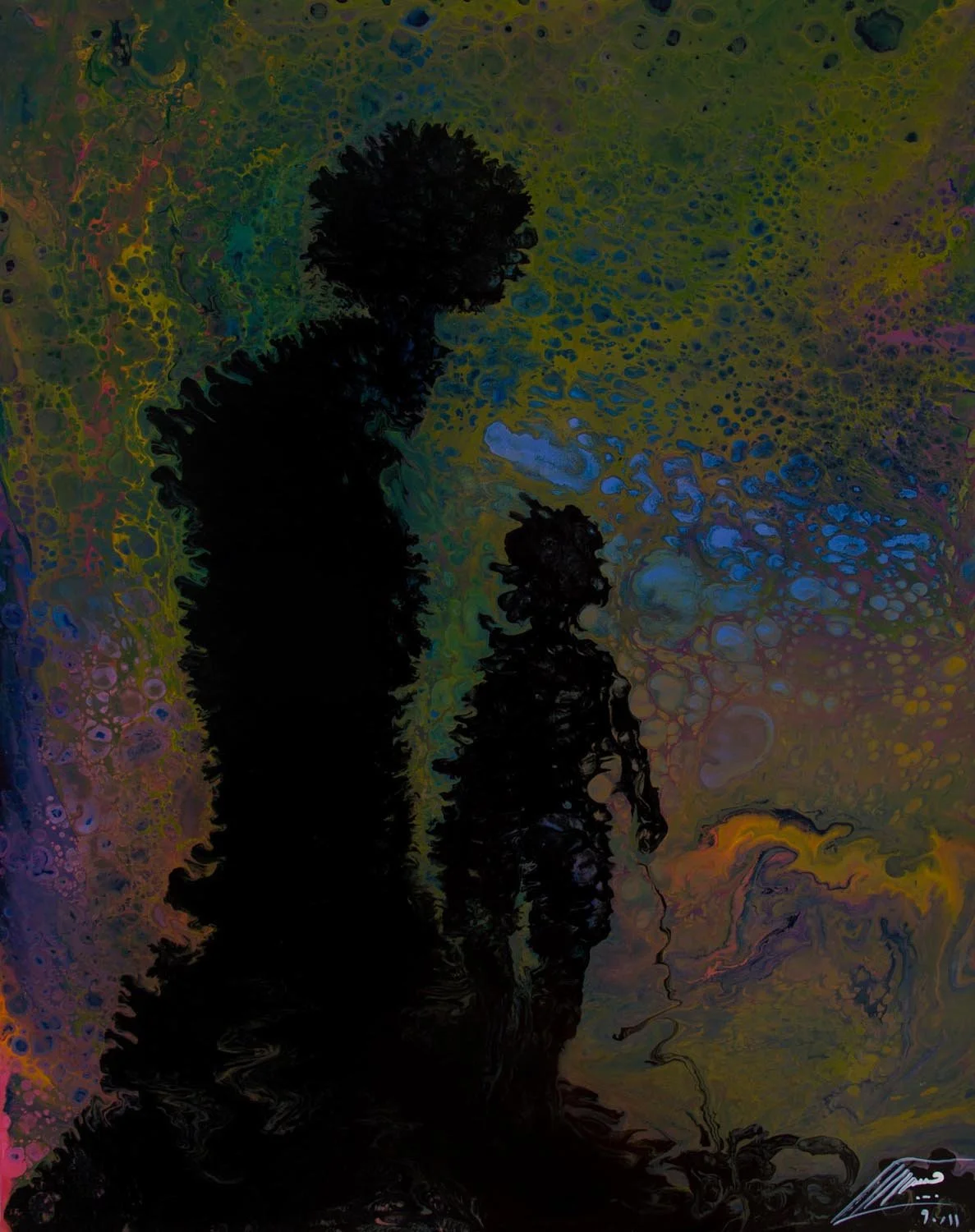
In No Distance in the Dark (above painting), Brumand establishes an open background and adds a black, rock-like mass under the influence of grief. Once realized, the mass deepens the melancholy of the field and begins to register as a human presence. Brumand develops it into a dark figure that she understands as herself immersed in the wound. That recognition prompts a smaller figure associated with her lost child. Seeing the two together intensifies the loss and changes the judgment of the entire work; light blue enters only after this accumulated sequence. Each consequence alters perception, and altered perception guides the next action. Brumand’s improvisation has become recursive: variation remains open, but every intervention answers to the history already present on the surface.
Recognizable faces, bodies, animals, trees, and landscapes often emerge through this process. Brumand calls attention to them after their material conditions have developed, rather than executing them from a complete prior design. Recognition adds an interpretive consequence. A curve that becomes a face changes emotional response, meaning, and the actions that follow; the figure begins participating in the further history of the work. Discovered figures became one of the mature practice’s most visible features, while chromatic, spatial, directional, and textural returns continued to guide paintings that remained nonfigurative.
The opening painting can now be understood as one such recursive history. Violet-blue movement produces a field in which vulnerable yellow is preserved; the body appears, the head develops, and recognition brings the face into focus. Blue keeps hope answerable to loss, while yellow keeps grief open to continuation. Because the alteration returns in both directions, the two contributions have become reciprocally consequential. Their expression also begins to depend on capacities supplied through the relation. The gaze is sorrowful and alive because grief and hope have changed what one another can express.
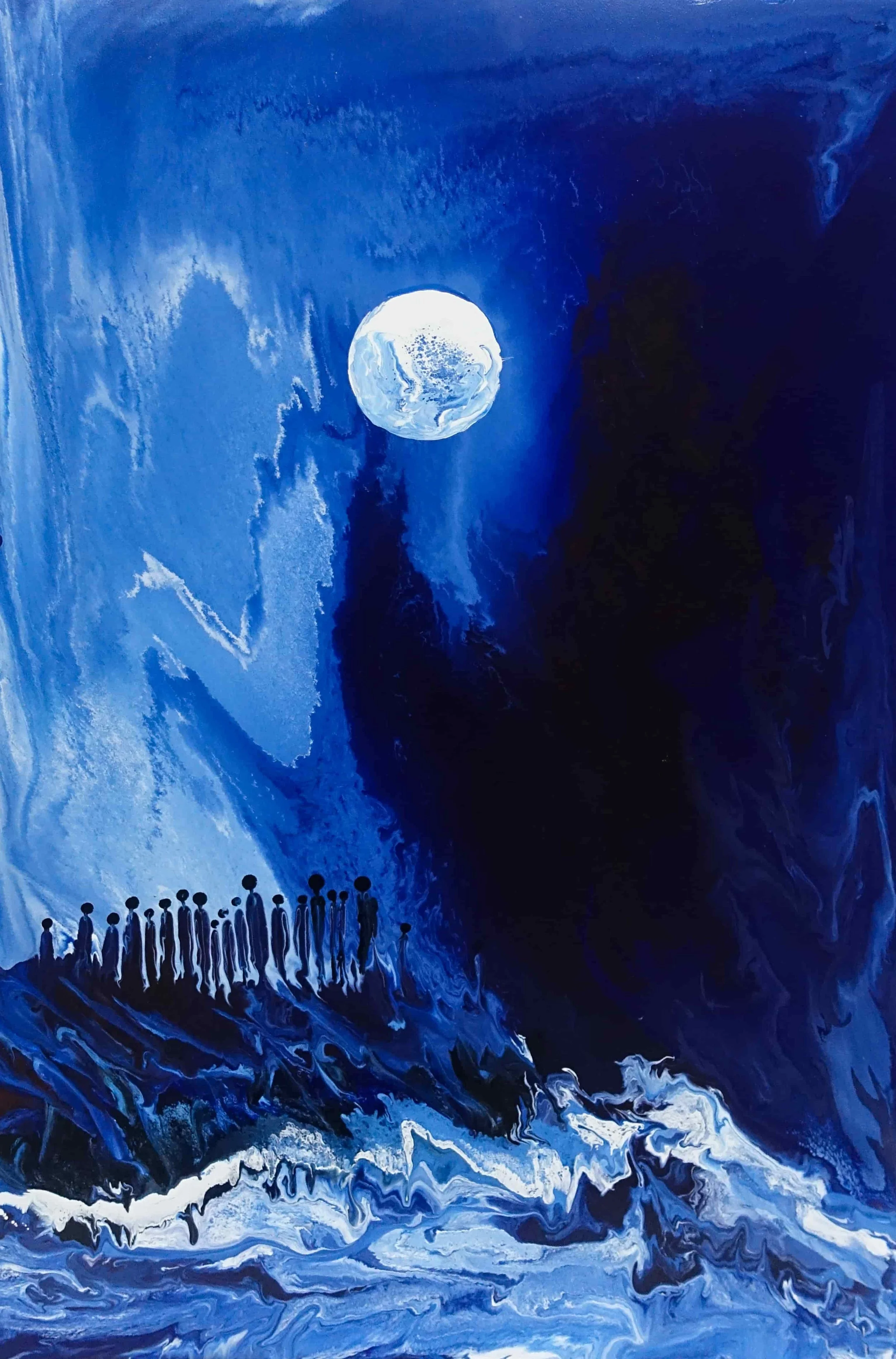
As Brumand’s practice matured, she increasingly judged relations by what they allowed participating references to do. The storm-and-moonlight painting makes this search visible. A pale moon and lighter blue passages extend through a dark field, reaching the ocean, atmosphere, and small upright figures. In Brumand’s account, moonlight carries life and possibility, while the storm carries fear, death, and loss. Earlier post-Zoya configurations could leave lighter possibilities local and fragile, requiring deliberate preservation before their consequences developed. Here light participates across the field while darkness remains active: the storm keeps possibility answerable to danger, and illumination prevents threat from occupying the entire future of the image. The work therefore makes the direction of greater compositional economy visible. Compositional economy compares what configurations enable with the recurring work required to maintain them. Under comparable conditions, one configuration has greater economy when its participating functions operate at least as fully with less repeated management of their interference, or perform more fully without additional management. Such management includes the suppression, compensation, or repair needed simply to prevent one reference from repeatedly obstructing another. Economy concerns functional achievement and recurring corrective cost, rather than visual simplicity or calm.
The unequal strength of possibilities gave selection a further role. Established grief-shaped configurations returned easily, while an unfamiliar light or figure could disappear before its capacities were known. Brumand sometimes preserved, strengthened, revisited, or tested a weaker variation so that its consequences could develop. Consonism calls this selective variation. The term names the evaluative decision to give a possibility time and consequence; tilting, knife work, placement, color, and revision are the means through which that decision becomes material. Later developments remain free to correct the initial choice. A protected variation may deepen the composition, change its function, or prove unable to remain in the work.
Through repeated reciprocal use, a relation can develop functional interdependence. This occurs when what each reference can do within the shared field materially depends upon a capacity supplied through the relation. The opening painting offers a clear test. Without grief, hope would lose the constraint that keeps it truthful to loss; without hope, grief would lose the capacity to preserve attachment while admitting a future. Each reference could remain active alone, but neither could produce the same organized expression. When this mutual reliance becomes recurrent and sufficiently established, the relation forms a bond. A bond becomes a consonant bond when each reference substantially helps the other perform its function and their remaining interference no longer requires continual suppression, compensation, or repair merely to keep the relation operative. Consonance lies in this reciprocal enablement, not in the disappearance of pain or tension. Grief continues to constrain hope, but no longer prevents every future; hope opens continuation without dissolving grief.
A mature bond acquires further continuity through recurrence and translation. Recurrence occurs when the relation becomes active again and consequences of its earlier operation still shape what follows. Translation occurs when the same functional organization survives a meaningful change in form, palette, subject, medium, or context without merely copying its earlier appearance. A later painting may look entirely different while preserving the relation in which grief constrains hope to remain truthful and hope keeps grief open to continuation. Each translated recurrence tests whether the bond can operate beyond the configuration in which it first formed. When its accumulated history begins to grade unfamiliar possibilities, guide subsequent decisions, and help the relation re-form after disruption, the bond has consolidated. It can then function as a composed reference: a new reference produced through composition. Its participants remain distinct, but their accumulated relation now supplies organizing constraints and capacities that none supplied independently in the same way. The composed reference can therefore organize what the artist perceives and does next while remaining open to later revision.
Across repeated paintings, Brumand reports recognizing compassion within the work, including compassion toward her own grief. Fidelity to Zoya changed accordingly. Love and remembrance no longer required suffering to remain the sole measure of attachment, while grief continued preserving the significance of Zoya’s life and absence. Brumand describes bringing pain to the surface and encountering images that contained more than pain; those encounters enlarged what she could contain and paint next. Her testimony gives the artistic history psychological significance. Painting and daily life nevertheless supplied different conditions: a relation could become accessible on a persistent, revisable surface before it became available elsewhere, and lived change could exceed what any finished image made visible.
Brumand’s later production extends far beyond a single trauma-centered appearance. Fluid fields, linear constructions, symbolic scenes, recognizable landscapes, stylized figures, circular compositions, and mixed approaches belong to the same evolving practice. Consonist art cultivates conditions in which differentiated references become materially consequential, enter composition, and develop relations that guide further work. A function is valid when it preserves a reality the work must continue to answer, even if the continuation built around it has become restrictive. In a corrective composition, another reference changes that restrictive continuation while remaining answerable to the valid function. The post-Zoya relation is corrective in this sense: grief preserves attachment and the reality of loss, while hope and compassion loosen the conclusion that fidelity requires a permanently closed future. Other works bring several valid but partial references into composition, allowing each to constrain and extend the others without a single one governing the whole field. Consonism is therefore a practice of consequential relation expressed through a plural artistic language.
The mature achievement is a compositional capacity rather than one final composition. Compositional capacity is the renewable ability to bring relevant references into a shared field where their consequences can be preserved, varied, and allowed to constrain and enable one another. Brumand’s practice can externalize emotional organizations, preserve their consequences, return them across changing states, support fragile alternatives, and test relations through renewed work. These conditions make composition possible again when an existing reference no longer answers adequately to reality. The capacity remains dependent on judgment, material support, attention, and circumstance; its value lies in keeping artistic and psychological development open. By the time the practice received its name, its central operations had already emerged through decades of painting.
When the Painting Began to Answer Back
In No Distance in the Dark, Brumand establishes an open background and adds a black, rock-like mass under the influence of grief. Once realized, the mass deepens the melancholy of the field and begins to register as a human presence. Brumand develops it into a dark figure that she understands as herself immersed in the wound. That recognition prompts a smaller figure associated with her lost child. Seeing the two together intensifies the loss and changes the judgment of the entire work; light blue enters only after this accumulated sequence. Each consequence alters perception, and altered perception guides the next action. Brumand’s improvisation has become recursive: variation remains open, but every intervention answers to the history already present on the surface.
Recognizable faces, bodies, animals, trees, and landscapes often emerge through this process. Brumand calls attention to them after their material conditions have developed, rather than executing them from a complete prior design. Recognition adds an interpretive consequence. A curve that becomes a face changes emotional response, meaning, and the actions that follow; the figure begins participating in the further history of the work. Discovered figures became one of the mature practice’s most visible features, while chromatic, spatial, directional, and textural returns continued to guide paintings that remained nonfigurative.
The opening painting can now be understood as one such recursive history. Violet-blue movement produces a field in which vulnerable yellow is preserved; the body appears, the head develops, and recognition brings the face into focus. Blue keeps hope answerable to loss, while yellow keeps grief open to continuation. Because the alteration returns in both directions, the two contributions have become reciprocally consequential. Their expression also begins to depend on capacities supplied through the relation. The gaze is sorrowful and alive because grief and hope have changed what one another can express.
As Brumand’s practice matured, she increasingly judged relations by what they allowed participating references to do. The storm-and-moonlight painting makes this search visible. A pale moon and lighter blue passages extend through a dark field, reaching the ocean, atmosphere, and small upright figures. In Brumand’s account, moonlight carries life and possibility, while the storm carries fear, death, and loss. Earlier post-Zoya configurations could leave lighter possibilities local and fragile, requiring deliberate preservation before their consequences developed. Here light participates across the field while darkness remains active: the storm keeps possibility answerable to danger, and illumination prevents threat from occupying the entire future of the image. The work therefore makes the direction of greater compositional economy visible. Compositional economy compares what configurations enable with the recurring work required to maintain them. Under comparable conditions, one configuration has greater economy when its participating functions operate at least as fully with less repeated management of their interference, or perform more fully without additional management. Such management includes the suppression, compensation, or repair needed simply to prevent one reference from repeatedly obstructing another. Economy concerns functional achievement and recurring corrective cost, rather than visual simplicity or calm.
The unequal strength of possibilities gave selection a further role. Established grief-shaped configurations returned easily, while an unfamiliar light or figure could disappear before its capacities were known. Brumand sometimes preserved, strengthened, revisited, or tested a weaker variation so that its consequences could develop. Consonism calls this selective variation. The term names the evaluative decision to give a possibility time and consequence; tilting, knife work, placement, color, and revision are the means through which that decision becomes material. Later developments remain free to correct the initial choice. A protected variation may deepen the composition, change its function, or prove unable to remain in the work.
Through repeated reciprocal use, a relation can develop functional interdependence. This occurs when what each reference can do within the shared field materially depends upon a capacity supplied through the relation. The opening painting offers a clear test. Without grief, hope would lose the constraint that keeps it truthful to loss; without hope, grief would lose the capacity to preserve attachment while admitting a future. Each reference could remain active alone, but neither could produce the same organized expression. When this mutual reliance becomes recurrent and sufficiently established, the relation forms a bond. A bond becomes a consonant bond when each reference substantially helps the other perform its function and their remaining interference no longer requires continual suppression, compensation, or repair merely to keep the relation operative. Consonance lies in this reciprocal enablement, not in the disappearance of pain or tension. Grief continues to constrain hope, but no longer prevents every future; hope opens continuation without dissolving grief.
A mature bond acquires further continuity through recurrence and translation. Recurrence occurs when the relation becomes active again and consequences of its earlier operation still shape what follows. Translation occurs when the same functional organization survives a meaningful change in form, palette, subject, medium, or context without merely copying its earlier appearance. A later painting may look entirely different while preserving the relation in which grief constrains hope to remain truthful and hope keeps grief open to continuation. Each translated recurrence tests whether the bond can operate beyond the configuration in which it first formed. When its accumulated history begins to grade unfamiliar possibilities, guide subsequent decisions, and help the relation re-form after disruption, the bond has consolidated. It can then function as a composed reference: a new reference produced through composition. Its participants remain distinct, but their accumulated relation now supplies organizing constraints and capacities that none supplied independently in the same way. The composed reference can therefore organize what the artist perceives and does next while remaining open to later revision.
Across repeated paintings, Brumand reports recognizing compassion within the work, including compassion toward her own grief. Fidelity to Zoya changed accordingly. Love and remembrance no longer required suffering to remain the sole measure of attachment, while grief continued preserving the significance of Zoya’s life and absence. Brumand describes bringing pain to the surface and encountering images that contained more than pain; those encounters enlarged what she could contain and paint next. Her testimony gives the artistic history psychological significance. Painting and daily life nevertheless supplied different conditions: a relation could become accessible on a persistent, revisable surface before it became available elsewhere, and lived change could exceed what any finished image made visible.
Brumand’s later production extends far beyond a single trauma-centered appearance. Fluid fields, linear constructions, symbolic scenes, recognizable landscapes, stylized figures, circular compositions, and mixed approaches belong to the same evolving practice. Consonist art cultivates conditions in which differentiated references become materially consequential, enter composition, and develop relations that guide further work. A function is valid when it preserves a reality the work must continue to answer, even if the continuation built around it has become restrictive. In a corrective composition, another reference changes that restrictive continuation while remaining answerable to the valid function. The post-Zoya relation is corrective in this sense: grief preserves attachment and the reality of loss, while hope and compassion loosen the conclusion that fidelity requires a permanently closed future. Other works bring several valid but partial references into composition, allowing each to constrain and extend the others without a single one governing the whole field. Consonism is therefore a practice of consequential relation expressed through a plural artistic language.
The mature achievement is a compositional capacity rather than one final composition. Compositional capacity is the renewable ability to bring relevant references into a shared field where their consequences can be preserved, varied, and allowed to constrain and enable one another. Brumand’s practice can externalize emotional organizations, preserve their consequences, return them across changing states, support fragile alternatives, and test relations through renewed work. These conditions make composition possible again when an existing reference no longer answers adequately to reality. The capacity remains dependent on judgment, material support, attention, and circumstance; its value lies in keeping artistic and psychological development open. By the time the practice received its name, its central operations had already emerged through decades of painting.